Masonry Equipment Efficiencies
Words: Matt Oklevitch
Words and Photos: Matt Oklevitch, Construction Robotics
The steady buzz of spirited banter on the scaffold is overshadowed momentarily by the unmistakable tone of a forklift as a Grout Hog pump is positioned into place overhead. Coordinated commands guide it precisely into location, and a few moments later, grout flows, effortlessly filling cores in a freshly laid wall section. Quick work is made of this process, and the team begins readying the mast climbers to begin raising the deck.
After a surprisingly fast yet smooth ascent, the hydraulic decks are raised securely into place, and the masons are instantly back to work with trowels in hand. With a smooth motion, a mason picks a large CMU with the audible “click” of the MULE’s pneumatic gripper, floats the block weightlessly to the wall and positions it precisely to the line, then releases it in place. A few quick taps with the trowel, and he’s on to the next block.
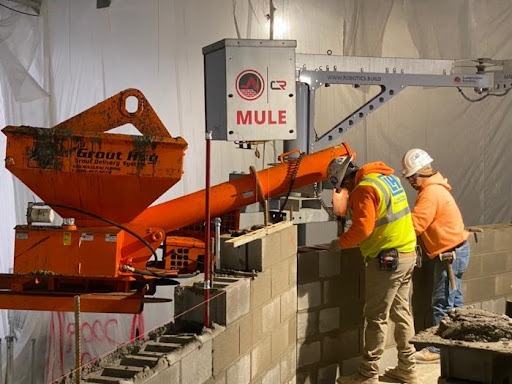 Pictured: Masons grouting a wall section from a Hydromobile deck with a Grout Hog pump
 These units are 32” CMU, allowing the mason to effectively lay twice the square footage with each block installed. This steady process of installation, decks raising, and grout flowing repeats throughout the days and weeks ahead. They are the processes and tools of a finely-tuned system of modern masonry, the evolution of a time-honored craft now enhanced by the efficiencies of today’s masonry equipment.
This real-life account of an ongoing masonry job site is one that is repeated daily. Whether out of necessity or due to the masons’ insatiable desire for excellence, many business owners are looking to optimize workflow and increase efficiencies and are actively converting tilt-wall and precast jobs to masonry by leveraging the time-saving and back-saving equipment available to them.
These modern tools of the trade aim to increase overall profitability for mason contractors by addressing a few key areas.
- Increased value. Keeping your skilled masons and laborers focused on high-value work by eliminating lower-value, time-consuming tasks is not only good business, but it is often necessary to retain good workers and attract new talent in today’s labor market.
- Increased production. Time is money. Every second that is not spent raising deck planks on a traditional scaffold setup, grouting by hand, or muscling a CMU over rebar, is time that can be spent laying more block. Additionally, leveraging a weightless-lifting device like MULE ensures that your crew can install the same block rate in the afternoon that they can at the start of that day and increases overall production exponentially when paired with the oversized CMU available from many block producers today.
- Increased safety. Eliminating unnecessary movement, cumbersome tasks, and general fatigue, whether on the scaffold or off, decreases the likelihood of injury and ensures that your crew gets home safely at the end of each day while maintaining their peak performance.
As the construction landscape continues to change, this is an opportunity for Masonry as an industry to evolve, allowing us to attract new talent, stay competitive, and retain market share in modern building design. The tools are available – we just need to build smarter.