Owens Corning and What To Look Forward To: Part Two
Words: Tiffany Coppock at Owens Corning, Dan Kamys at MCAA
Editor’s Note: Dan Kamys, Editorial Director at MCAA, recently had the chance to sit down and talk with Tiffany Coppock with the MCAA’s new Strategic Partner, Owens Corning. Part one of this interview can be found here.
Dan Kamys: Hey, it's Dan Kamys with the Mason Contractors Association of America. I'm here with another part of my conversation that I had with Tiffany Coppock from the Owens Corning team. Again, Owens Corning is a new Strategic Partner of the MCAA and we had a great conversation about FOAMGLAS Perinsul SIB. Here is the next segment.
Tiffany Coppock: Thanks, Dan! Happy to join you.
D.K.: So, given that the focus seems to be on energy efficiency and the increasing importance of energy efficiency, how much of a problem is thermal bridging now?
T.C.: Well, we know that insulation helps to reduce the loss of energy through the exterior wall and particularly there has been one area of thermal bridging throughout the United States, as far as our traditional design goes, with masonry veneer but also with other construction types and we have a new insulation product, FOAMGLAS Perinsul SIB, which is a cellular glass that is able to withstand the loading of that heavy masonry veneer. So we’re really excited to be able to solve that final problem of thermal bridging in an effort to create truly continuous insulation so that we can help to reduce energy loss.
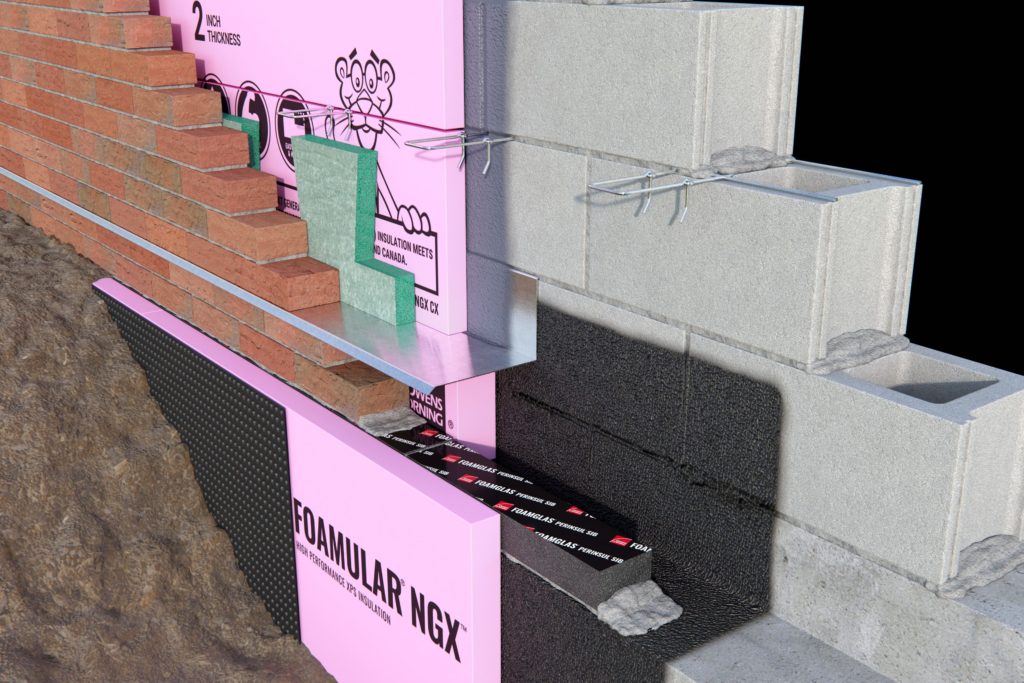
D.K.: So, Tiffany, as you get to know our members more, you’ll understand that they like to get right to the point and I think they’d want me to ask: why hasn’t this issue been addressed before? Why is it finally being tackled now?
T.C.: Absolutely, I think, unfortunately, traditional design has known about this problem but we really haven't had a fantastic solution. Previously all of the insulation products that we worked with just exhibited a little bit too much deflection for being placed under a masonry wall. So, our solution was to provide additional insulation in other areas to try and offset for that energy loss or completely ignore the problem entirely, which, of course, we don’t want to do but I think it’s starting to come more to the forefront as we really do button up our buildings so much better, as we start to turn an eye towards net zero energy buildings or net zero energy ready buildings. We’re really going to be paying significantly more attention to all of these thermal bridges throughout the building. Again, previously I’m sure your members have constructed buildings with no continuous insulation at all, and seeing the energy benefits of introducing continuous insulation. So, this is just one more solution to that problem.
D.K.: Thanks again, Tiffany. We really appreciate this conversation. T.C.: Thanks so much, Dan.