Mast Climbers – A World Of Possibilities
Words and Photos: FRACO
Mast climbing work platforms are often associated with the building construction sectors. However, the fields of application of this lifting equipment are much more numerous, and their uses are overflowing in the industrial sectors and, more particularly, in pulp and paper production.
TRADITIONAL AND NEW MARKETS
For over 25 years, mast climbing work platforms have been part of the decor of the world of building construction. If they were initially popularized by masonry work on buildings of several stories, they quickly proved their usefulness for other types of applications such as the installation of windows and curtain walls, E.I.F.S, of metal panels, and repair restoration and deconstruction of buildings. Consequently, the construction of multi-story buildings was made easier by the presence of lifting equipment capable of promoting productivity gains.
Before the end of the 1990s, the profits generated by the use of mast climbing work platforms were quickly transferred to other dynamic sectors at that time: infrastructure and power generation. North American mast climbers manufacturers then adjusted and developed accessories to allow important general contractors to perform formwork and concreting related to repairs of bridges and road interchanges. The mast climbing work platforms have also evolved to allow the realization of dam restoration projects and concrete repair of structures present on thermal power plants. Over the years, the proliferation of work platforms on the market has pushed general and specialized contractors to use these lifting equipment in industrial sectors as varied as oil and gas exploitation and terminals, petroleum refining and chemical processes, mining, cement production, etc. One of the industrial sectors that quickly adopted mast climbing work platforms is that of pulp and paper production.
For 20 years, Fraco Products Ltd, the only North American manufacturer of work platforms, construction hoists and industrial elevators, has been providing solutions that facilitate access to the various transformation devices of pulp and paper plants and mills. The company has developed extraordinary expertise in the supply of equipment used for the construction of tanks and vessels with several hundred tonnes of capacity, whether for laying outdoor bricks or structural ceramic tiles found inside these tanks. In 2000, Fraco work platforms were used to build the largest high-density pulp storage vessel in La Tuque, Canada. In 2005, the company supplied the equipment used to construct five (5) pulp storage tanks during the expansion of a paper recycling plant located in Scarborough, Canada. In 2016, in collaboration with TAC (Montreal, Canada), a specialist in abrasion and corrosion resistant coating systems, Fraco supplied eight (8) FRSM-20K work platforms, which were used for the construction of a high density tank for bleached kraft pulp with a capacity of 1000 tonnes in Lewiston, Idaho.
IMPORTANT PROJECT
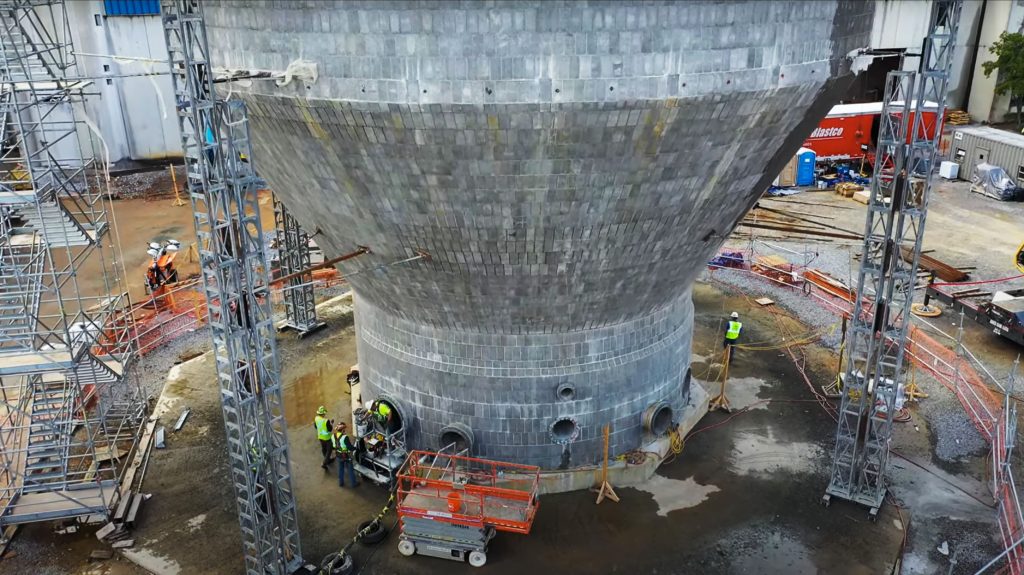
Fraco’s was involved in the construction of a 650-ton high-density reservoir at the Riverdale Mill of International Paper (Memphis, TN) located in Selma, Alabama. This project was carried out by Universal Blastco (Sumter, SC) in collaboration with TAC. The work platforms present on the site were supplied by Mastclimbers LLC (Grayson, GA), a long-time partner of Fraco Products Ltd. Mastclimbers LLC also supervised the installation of the equipment by providing a foreman and a few installers.
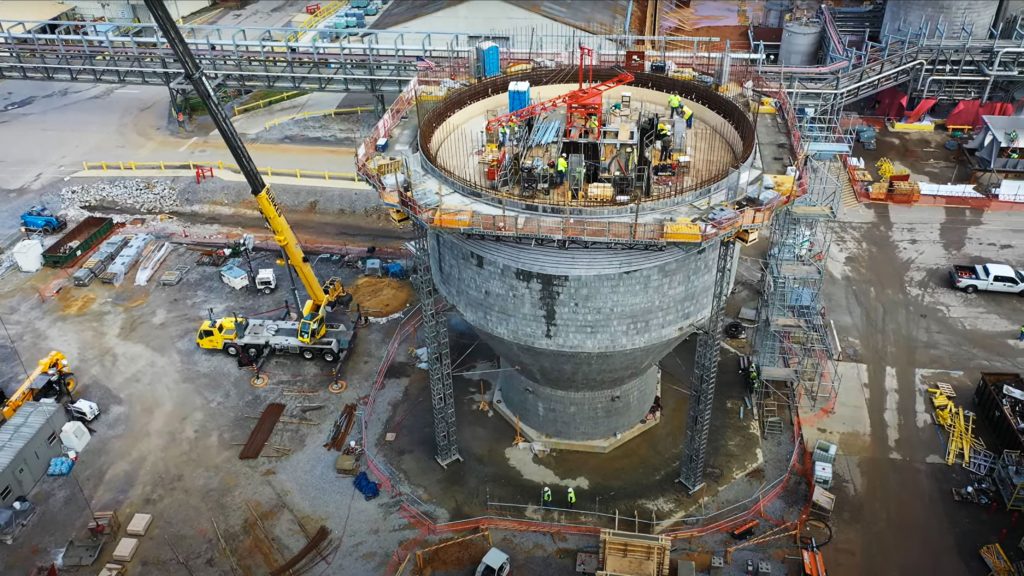
To carry out the work, the Fraco technical team proposed the use of four (4) FRSM-20K units outside the tank and four (4) others inside the structure. With a diameter of 34' 4'' at its base, another of 60' 4'' at a height of 92', the vessel presented several challenges that the Fraco team took up by offering to use various special parts.
OUTSIDE UNITS
The configuration of the 24' long FRSM-20K motorized units installed outside the tank was established to encircle the tank by using four (4) 30' bridges to support the end of each 8' 4'' extension. Special 42"-long bridge adapters have been developed to facilitate angular positioning. In addition, each unit was mounted on a special ground base capable of receiving two masts attached to each other, namely the ascending mast as well as a reinforcing mast which allowed freestanding use over a height of 40’.
INSIDE UNITS
Installing the four (4) FRSM-20K units inside the tank was also a challenge. The configuration chosen had to take into account the flared shape of the structure. Two 34'8 ’’ units were opposed to covering most of the interior circular walls. They were supplemented by two (2) other 23 ’units supporting two 30’ transverse bridges, also fitted with special bridge adapters. The respective masts of each of the four (4) motorized units were bolted to special bases anchored at an angle of 31 degrees at 21’ from the ground. This configuration made it possible to install a concrete pouring arm supplied by a pump located on the ground on the two transverse bridges. The workers were thus able to pour concrete continuously into the inside perimeter of the tank.
The completion of this concrete tank construction project clearly shows that mast work platforms can prove their usefulness in sectors other than those related to construction. The proliferation of this type of project using Fraco work platforms also proves that clients and general and specialized contractors can benefit from significant productivity gains which often translate into financial savings.
Fraco Products Ltd is a Canadian manufacturer of mast access systems such as work platforms, construction elevators, industrial elevators, and transport platforms. This equipment is intended for the construction of buildings, as well as for industrial markets, infrastructure works and the power generation sector. Fraco also has a solid reputation in developing access systems for special projects. The company primarily serves the North American and European markets but remains open to the world.