A Hometown Hero Comes Home

Words: Larry AlamilloThe day of May 25, 2015, was unlike any other Memorial Day celebrated in the historic Borough of Ephrata, Pa. On this Memorial Day a special ceremony took place: the dedication day of a Veterans’ Memorial Plaza.

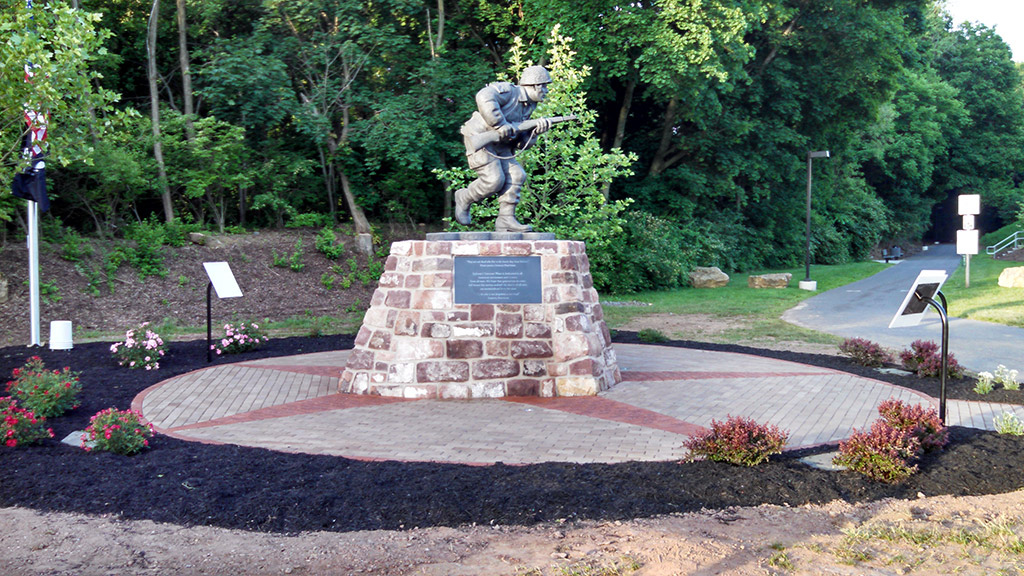
The centerpiece of the plaza is a statue of one of World War II’s best known soldiers, Major Richard D. Winters, hero of the bestselling book and Emmy-winning TV miniseries, “Band of Brothers.” The dedication ceremony took place to honor those whose sacrifices have paid the price for our and other nations’ freedoms.

Major Winters, who passed away in 2011, was a humble person who was known for his leadership and humility. He was born and is buried in Ephrata, and he is a hometown hero. Making a statue of him as the centerpiece of the plaza was a form of recognition for his and his men’s daring actions during the D-Day invasion, and it became a community-wide effort.

Constructed a short distance from Winters’ boyhood home, along a trail also named in his honor, the plaza is of a circular design measuring 28 feet in diameter and incorporating more than 1,000 tan- and red-colored brick pavers. Brick-red pavers, 200 of which are engraved with the names of veterans, emanate from the center to create a five-point star.

The bronze statue is a duplicate of one erected on June 6, 2012, in Normandy, France; both were created by sculptor Stephen Spears.

Projected to cost $50,000, the plaza — thanks to an outpouring of donations and in-kind services from individuals and businesses — cost just a fraction of that amount, said monument committee chairwoman Rebecca Gallagher.

As news of the project spread, help came from around Lancaster County. Architect Mark Schillaci of Schillaci Architects Ltd. provided the plaza design, and a host of businesses made that vision a reality.

The centerpiece of the plaza is a statue of one of World War II’s best known soldiers, Major Richard D. Winters.
On land donated by the Borough of Ephrata, excavation for the plaza began on April 13, 2015, completed by D.L. Burkholder Inc. In the center of a freshly dug shallow circle, a three-foot-deep hole was excavated, where the pedestal supporting the statue would be located. Concrete forming and reinforcement were donated by Richard J. Burkholder Inc., using 30,000 pounds of concrete donated and poured by Rohrer Quarry.

After the concrete hardened, hand-cut field stones, salvaged from a farmhouse dating to the late-1800s, were donated by Richard Stauffer. These were used as facing on the five-foot-high pedestal. The stones were placed free of charge by a trio of masons from Cocalico Builders Ltd. Granite plaques, displayed on three sides of the pedestal and containing quotes, including some by Winters, along with donors’ names, were engraved and mounted, gratis, by Gingrich Memorials. The committee paid only for the granite.

Vince Fry of Frysville Farms did the landscaping, including laying the pavers. “When I heard about this, I thought, ‘We have to get this thing in Ephrata,’” he said. “It’s just a unique way to honor a famous son.”

Even though his nursery/landscaping business was in the midst of its busy delivery season, Fry donated his services. He cut the pavers to fit the design using a stone saw, and laid the pavers, assisted by volunteers, including local high school students and the Mayor of the Borough, Ralph Mowen.

Electrical work and lighting were provided by Scott R. Cover. Tree trimming and ground clearing of a wooded slope behind the plaza were donated by Armer Tree Services. The bronze statue was moved from storage by a forklift provided by Musselman’s Lumber and mounted on its pedestal by Line Specialties Inc.

Items actually purchased, generally at cost, by the committee — excluding the statue — were the pavers, granite slabs, three metal plaques located around the plaza, four benches and a flagpole. The pavers were purchased from Glen Gery Inc.

This memorial will be a reminder for generations to come that freedom is not “free.” It comes at a high price: the sacrifices of those who gave their lives, and the veterans and all the women and men who, on our behalf, are still serving to preserve it.
The Importance of Instructor Support
April 2026

Whether you are a new or veteran masonry instructor, we all need support throughout our careers. We can never stop learning, and keeping up with ever-changing technology, materials, and installation techniques can be overwhelming alongside the everyday pr

Vibing Masonry #11: Innovative Concrete Masonry Technologies in Healthcare Design
April 2026

In the high-stakes environment of healthcare design, every material choice is a clinical decision. Architects, engineers, and facility administrators are tasked with creating spaces that are not only resilient and code-compliant but also conducive to heal

Why Termination Bars Still Matter: A Practical Look at Long‑Term Flashing Performance
April 2026

In recent discussions across the masonry industry, I have heard termination bars described as “old school.” The implication is that with modern materials, primerless peel-and-stick flashings, advanced sealants, and structural insulated sheathing, mechanic

Building Solutions: The Critical Role of Cavity Space in Masonry Moisture Control
April 2026

Long before “rainscreen” became a popular term in building science, masonry cavity walls were functioning on that very principle. A brick veneer cavity wall is designed with the expectation that water will penetrate the exterior