Member Story: Block-Lite
Words: Ben Kurtze
Words: Ben Kurtze, Sales & Marketing Officer of Block-Lite Co., Inc.
Photos: Block-Lite Co., Inc.
Solar Energy Solutions: How Block-Lite Runs On Solar Power
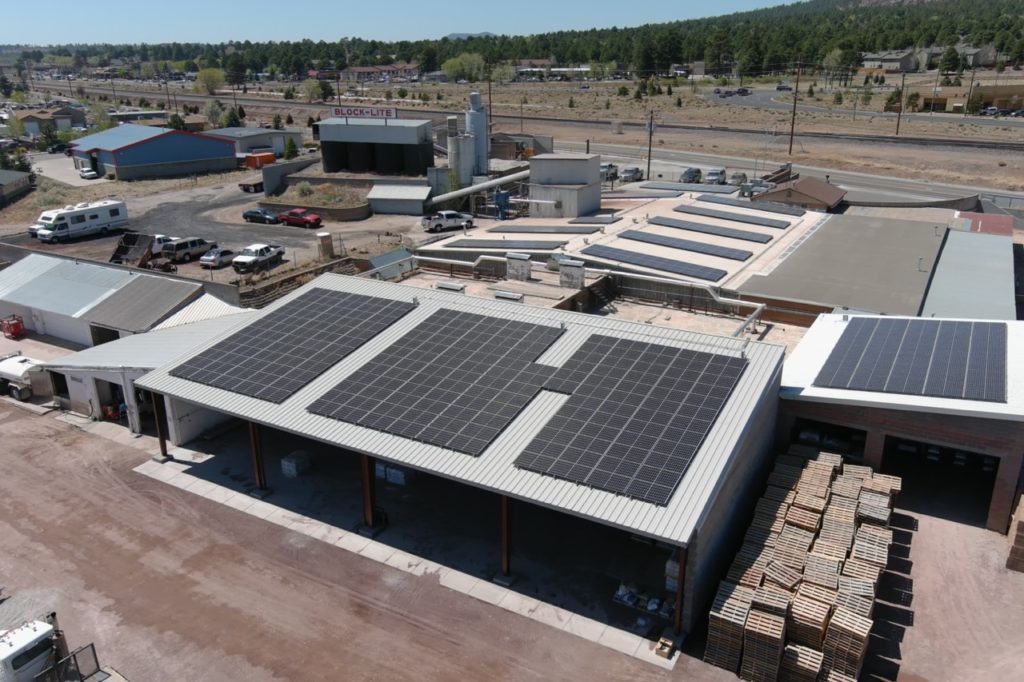
Picture this; it is a bright and early morning in the mountain town of Flagstaff, Arizona. The sun hangs low in the cloudless sky. On the east side of town, Block-Lite’s conveyor belts are whirring, and its state-of-the-art machines are already up and running, manufacturing the blocks, pavers, and other masonry products that will provide contractors across the state with the materials they’ll need to complete a wide range of projects. The sun has barely risen past the iconic peaks that Flagstaff calls home. However, the energy provided by the sun and captured by the 157kW roof-mounted photovoltaic system is powering Block-Lite’s entire manufacturing process.
 default
Block-Lite has long been a staple in the Flagstaff community. The 3rd generation family-owned and operated business was purchased by then-employee Glenn Ross, his wife Janie, and their son Chris and his wife, Nancy. Now, Block-Lite is co-owned by siblings Ryan Ross and Christy Maycumber, grandchildren of Glen and Janie, and the children of Chris and Nancy. The Ross siblings have been working at Block-Lite since they were young, growing up working on the many machines and with the many people that produce about 200 different kinds of landscaping and building blocks. Block-Lite’s tradition of excellence and a strong commitment to investing in its staff, customers, and community has been passed down from generation to generation. Driven by this commitment and the love of Flagstaff’s natural beauty, Ross and Maycumber looked for ways that Block-Lite could become more sustainable.
Block-Lite's solar project kicked off in the spring of 2020, making it the first locally-owned solar-powered manufacturer in Flagstaff! The project was unique in accommodating the shape and structure of Block-Lite's facilities. Construction was completed across multiple roofs that house Hanwha's 325 Watt Qcell solar modules to take advantage of the open space around the factory and the clear skies to capture enough solar energy to power the plant's daily operations.
Block-Lite is lucky to call Arizona its home as it is well-suited for solar energy production. Arizona has abundant sunlight and large expanses of open land, making it an ideal place to take advantage of solar technologies. Block-Lite's photovoltaic system is estimated to produce an impressive 3,926,000 kilowatt hours of electricity over its lifetime. According to the United States Environmental Protection Agency, that is enough clean energy to offset 2,776 Metric Tons of carbon dioxide from being emitted. This is the equivalent of 3,078,348 pounds of coal being burned or 6,442 barrels of oil being consumed.
According to the Office of Energy Efficiency & Renewable Energy, the United States has vast solar rooftop potential that– if utilized– represents over one terawatt of potential solar capacity. This would have an immensely positive environmental impact on communities across the nation! Although there is still a long way to go, Block-Lite takes immense pride in setting an example of how the manufacturing industry, and more specifically, the concrete masonry industry, can play a part in making a positive difference in the environment. After all, Block-Lite believes that providing quality and viable products to the community of Flagstaff should not come as a compromise to the quality and viability of Flagstaff itself.
In addition to its solar project, Block-Lite gives back to its community in various ways. They are proud sponsors of Coconino Community High school’s athletic department, Summit Gymnastics Academy, and the Arizona State Troopers Charity. They have donated material for over 100 local building projects as well as educational programs and events. Many of which have been in partnership with Habitat for Humanity. Most recently, Block-Lite donated materials to help build back the homes of those victimized by the devastating Tunnel Fire as well as pledged to match any of its employee’s volunteer hours– dedicated to helping the victims– with bonus vacation hours.
As a result, members of the community often turn to Block-Lite first when purchasing their masonry materials. Block-Lite’s units can be spotted in countless buildings all around the community, from residential gardens and patios to 80,000 units used in the construction of the Kemper and Ethel Marley Foundation Astronomy Discovery Center at Lowell Observatory. Just as it did three generations ago, Block-Lite strives to be efficient, organized, and innovative while providing quality and viable products to invest in its staff, customers, and community.