A Place for Fire in the Modern Age
Words: Tyler Mcclave
Words and Photos: Tyler McClave, President of Superior Clay
A masonry fireplace- one that is built by hand, out of brick, mortar, and clay tiles- is the best version of a wood-burning hearth one can put in their home.
Whether it is used primarily as a warm place to gather with family and friends during the holidays, or a unique one-of-a-kind piece of art crafted by local artisans and displayed like a sculpture as the centerpiece of the home.
The masonry industry has a responsibility to maintain this practice of building one-of-a-kind pieces of art that are truly remarkable and a part of our heritage so that it does not fade away.
By using proper design and the highest quality materials, a masonry fireplace can be an easy sell to a homeowner, for its upsides are tremendous!
Every good fireplace starts with a good design. Some designs are better than others, and client preference will have some influence on the design, but if sized properly and meets code, an installation will last for generations.
Two of the most popular designs are Conventional and Rumford. Conventional fireplaces tend to have a lower height compared to width and a back wall which leans forward. Rumford designs are typically taller (as tall as they are wide) and have a straight back wall. Some homeowners prefer the Rumford style for the taller firebox and efficient heat output. Masons like the Rumford style because the three straight walls make it easier to build, plus the Rumford style lends itself to better drafting by eliminating turbulence; also, the curved throat creates a laminar flow up through a relatively smaller throat opening and up through the chimney, thus, fewer callbacks from customers who have smoke rolling out of the front of the fireplace.
Safe and Sustainable
What makes site-built masonry fireplaces the safest wood-burning installation? A rich history of tradition and code adaptation. Masonry fireplaces are built to code not accredited by for-profit independent labs. The process for writing the code is all-encompassing and open to any public comments for amendments or discussion.
Code requires masonry fireplaces be built with 8” of solid masonry around the firebox, plus 4” airspace in the back and 2” airspace on the sides. Six inches of solid masonry around the smoke chamber is required. Testing shows that mass created by this masonry protects any of the surrounding combustible materials from ever reaching warm temperatures that could be of any concern, even in the event of a chimney fire.
This method also makes the fireplace very sustainable. If comparing to a pre-fab kit made of metal and refractory cement-based components for the backup with only a layer of firebrick in the firebox, the life of the masonry will outlast zero clearance kits by many generations.
As for the masonry chimney, recent code changes have made it easier to build and could have positive impacts on building structurally more stable homes in years to come, pending further research. Wherein previous code requirements mandated 4-inch thick masonry surrounding the clay flue, plus a 2-inch air space for clearance to combustible materials. Now, the chimney can be built only 8 inches solid around the flue (a bond break is required surrounding the flue), so now combustibles, including framing, can abut directly to the masonry chimney. This creates a much easier building process and lowers the cost in labor and materials where 12” of solid masonry is no longer needed. It also provides the potential for using the chimney as an anchor for the rest of the home, where environmental concerns, such as wind resistance et al., may be a concern, but more research is needed on this topic.
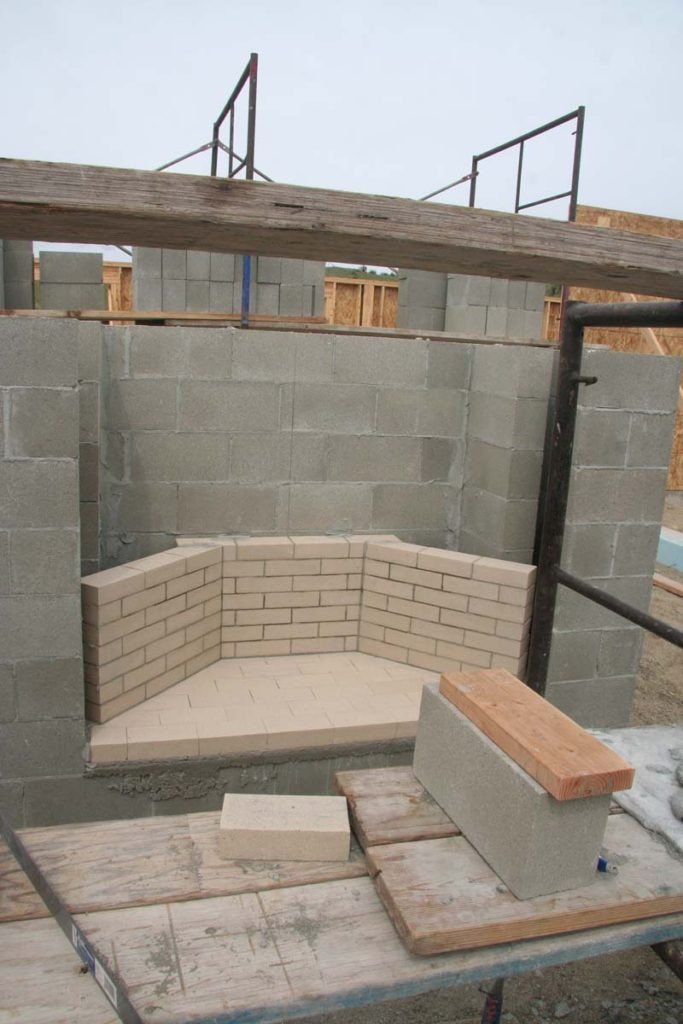
Other recent advances in the code address the mortar used to build masonry fireplaces. All mortars used in the fireplace interior must be qualified as Refractory Mortar and meet ASTM C-199. Mixtures that involve Portland cement will not qualify. These mortars are required by code to lay the firebrick and flues in a masonry fireplace. By not using approved refractory mortar, installers are exposed to liability.
According to most reason data from the NHAB (Share of New Homes with Fireplaces By Paul Emrath on September 16, 2019), over 40% of new homes have at least one fireplace. Although the numbers are currently in a downward trend, that is still a lot of fireplaces. How a consumer relates to a fireplace will determine whether they choose to build one in the future. The most important factor in consumer relationships with fireplaces is making sure that they work properly. There is nothing more frustrating than starting a fire just to have it smoke up the house. By understanding make-up air requirements and installing them at the time of building, these issues can be avoided. Code requires 6 square inches within 24 inches of the firebox opening. Fires are dynamic and need different levels of make-up air at different times, but properly sizing your fireplace according to effective flue area will greatly decrease issues with a smoky fireplace. (1/10 firebox opening or 1/12 for round flues.)
Your home is also dynamic. Your furnace, hot water tank, bath fan, kitchen hood, etc., all exhaust air from the home. Your fireplace has the potential to exhaust more than all these appliances combined. For a fireplace to work continuously without spilling smoke out into the room, air must be replaced once lost up the chimney or out of other appliances. This can be done naturally with an air intake or mechanically with an air exchanger.
Historically firebrick has been associated with a single color, unattractive yellow. Now firebrick is available in a full array of colors, including black, grays, reds, and more! The growth of the interior design industry has influenced fireplace design to diversify to the point where you can choose a firebrick color to match the patina of the room it occupies.
Masonry Fireplaces are the safest and most sustainable options for a warm hearth. Building them is considered a lost art, but many in the industry are determined to keep the fire burning!