MORTAR BOARDS VS. OSB
Words: Julie Lynch
Words: Julie Lynch, Marketing Manager at MARSHALLTOWN
Photos: Marshalltown
Put an end to wasted time and mortar!
Oriented strand board (OSB) was once the standard—and cheapest—mortar board option for contractors, but those days have since passed. Today, with advancements in manufacturing and material technology, advanced polymer mortar boards reign supreme.
A mortar board is designed for a rather simple task; hold mortar, stucco, or plaster precisely where it’s needed (right next to the job at hand). They are also often used to transport the material from where it’s being mixed (often on the ground) to where it's being used (often on scaffolding). Advanced polymer mortar boards are strong, lightweight, non-porous, and UV-resistant. Their size and weight make them easy to move around the jobsite, and their design frequently includes an integrated handle.
If you have never tried an advanced polymer mortar board, you are wasting unnecessary time and money. There are many options to choose from when it comes to advanced polymer mortar boards, so we’ve made it simple for you. When shopping for your next mortar board, here are some key features you will want to look for:
HEAVY-DUTY CONSTRUCTION WITH REINFORCED RIBBED BACKING
You are going to want your mortar board to be able to withstand a heavy load. Look for one that is super tough and has been reinforced, so it will hold up to 150 pounds with little flex.
IMPACT RESISTANT
Durable, impact resistant mortar boards are nearly indestructible. You’ll want your board to last, so finding the right construction that can handle the daily abuse of trowels, shovels, and hammers is essential.
UV-RESISTANT
UV-resistant polymers help your mortar board last in both hot and cold climates and help prevent the sun from having a negative impact on the board’s other desirable properties.
WATER RESISTANT
When your mortar board isn’t soaking up moisture (like OSB), not only is it eliminating wasted material (or time retempering), it is allowing the moisture to stay in the material, which extends the workability by as much as 30 minutes.
INTEGRATED HANDLE FOR LIGHTWEIGHT PORTABILITY
This is one of those options you may not realize how much you needed it until you have it. Look for boards with integrated, ergonomic handles. They are much more comfortable to carry and can reduce the chance of injuries common on jobsites.
2’ X 2’ BOARD
Size matters. Look for a mortar board around 24” x 24”. Not so big as to be difficult to carry, yet large enough to hold a nice batch.
LESS THAN 6 POUNDS
If you have multiple boards needed on a jobsite, you are going to want boards that allow you to carry several at a time. Carrying multiple boards at once means a faster setup and quicker teardown.
If you’re thinking that is all great, however, your preference is using mortar pans, you can find many of these same features with advanced polymer mortar pans. Look for impact-, UV-, and water-resistant pans. They should have handles on both sides to assist with transporting, and if you can find them with reinforced handles, that is going to make a difference with ease of handling. It is best to find an open-faced design with approximately a 6” depth in order to make it easier to remove material. And weight really makes a difference here, so finding one that is no more than 8 pounds gives your arms and back less load when carrying multiple pans. Last, look for a pan that is engineered to carry up to 225 pounds or 1.75 cubic feet of material with minimal flex.
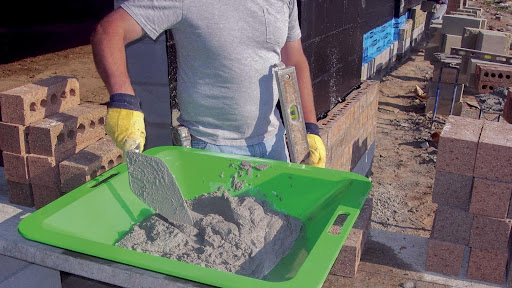
If you’ve never seriously thought about trying out an advanced polymer mortar board (or pan), all of these benefits should be enough reason for you to at least consider using one. You now have all the information in your back pocket of what to look for if you ever decide to shop for one. We believe that once you try one out, you’ll never go back to OSB.