Principles And The Challenges Of Change
Words: Jude Nosek
Words: Jude Nosek
If you have been reading On The Level at all over the last few years, you will not be surprised that on my refrigerator, I have a mission statement and some best practices for my family. I wholly admit I am nuts about this kind of thing. By that I mean, I recognize my choices and actions for organization and structure are not normal. Over the course of my career and life, I have found some helpful strategies and tactics, useful rules of thumb and interesting techniques that help me feel less anxious and more fulfilled. The effort I put into this type of behavior really comes down to this: do I feel better when I act in accordance with these ideas and principles? If the answer is “yes,” I keep it. If it is “no,” I change it or find a better way.
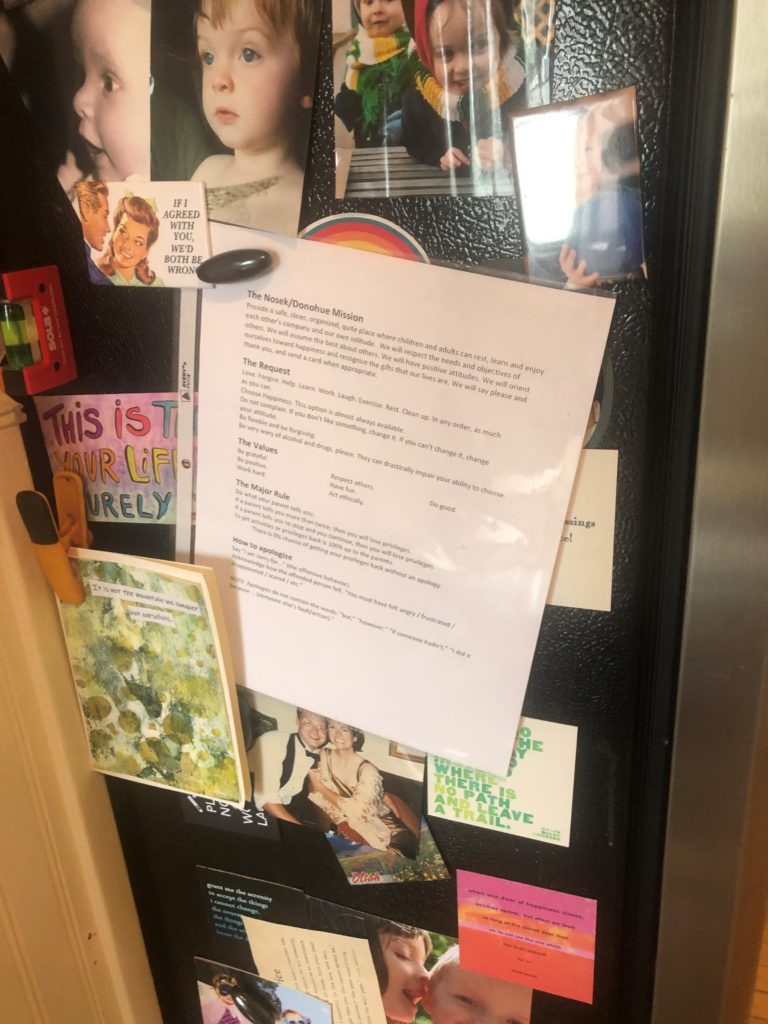
These tools help me to organize myself and my time amidst ALL the options. I like to I feel good about how I’ve spent my time. So, the list on the fridge is mostly for me. This is good, because it’s still there and my kids have been off at school for years. I was inspired by Steven Covey, and his famous book, The 7 Habits of Highly Effective People. I did not subject my kids and my wife (of nearly 27 years) to the rigors of all his suggestions. I did, however, suggest we consider a few. I’ve also nicked Keson’s Values: Be Positive. Work Hard. Respect Others. Have Fun. Act Ethically. Do Good. Some others I picked up from my family members and mentors throughout my life: above all, be kind; it is never too late say “thank you,” or “I’m sorry.” I am certain that my acquisition of these simple axioms is no longer always conscious. I read and modify the tenants from time to time. I don’t force them on anyone, I don’t even offer them unless someone asks. Here is our family mission:
Provide a safe, clean, organized, quiet place where children and adults can rest, learn and enjoy each other’s company and our own solitude. We respect the needs and objectives of others. We assume the best about others. We have positive attitudes. We orient ourselves toward happiness and recognize the gifts that our lives are. We say please and thank you (and we send a card when appropriate).
Now, it doesn’t always work seamlessly. While it’s been relatively safe, it isn’t always clean, organized, or quiet—especially when a family of squirrels gnawed their way into our attic. We do try to move back to these ideals when we find ourselves straying too far. That has been very helpful, especially for me. The same has been true for my professional life, and for our company.
During our rebranding/rebirth right after the housing crisis years of 2008-2010, we set our course (vision), our SOPs (mission), and our principles (values).
Vision: To be the world’s most trusted source of measuring and marking products.
Mission: To provide reliable, innovative, and easy-to-use measuring and marking products to people who are passionate about their work and getting it done right. We accomplish this by aligning our service, design, manufacturing and distribution capabilities to meet the precise needs of our customers.
Values: Be Positive. Work Hard. Respect Others. Have Fun. Act Ethically. Do Good.
With these guardrails in place, we chose to tackle certain strategies (e.g., redesigning our chalk line reels and partnering with SOLA) and spent less time on others (e.g., commodities and non-core products). Having these in place and evaluating what we are doing against them has helped us make up our minds more easily and has transformed how we choose to go about these undertakings as well.
Things change, and we need to adapt and to change and to grow and having this course set is helpful.
Standard Operating Procedures
On a daily/weekly basis, challenges arise that need our attention, like the squirrels in the attic, for instance. Or the family trip that had to be postponed for a day when I cracked my windshield while putting a bike on the roof-rack. Things happen and we need to adjust. I know it’s going to come as no surprise, but I have found a system for that too: Top 1/Next 4 priorities.
This one I acquired from Verne Harnish’s Mastering the Rockefeller Habits (though I tweaked the name a bit).
Here is how it works. Each day (usually the night before) I make a list of what I need and want to accomplish next. I evaluate each item with a few questions: is this thing time sensitive, how important is it, who can do it, how long do I think it might take?
Then, working with my boss if necessary and my coworkers when necessary, I parcel out the tasks or adjust them from yesterday’s list. This is a picture of the white board I made up to help us keep track. Here is the critical step. I start working on the Top priority and stick with it until I need a break or the project reaches a good place to pause. Then, I take a break. When I return, I either tackle that priority again OR one of the other four. If I find myself doing something NOT on the list, I either stop it or find a spot for it on the list. It’s that simple. When I get a request from my boss and other department heads, I ask, “What are the new priorities?” My team and coworkers adjust our priorities as needed daily or weekly. We all know what’s going on, so there are no surprises.
My suggestions for implementing the Top 1/Next 4 Priorities
- make it visible (some electronic systems like Teams have functions for this).
- Review it often with those in charge AND with those who are doing the projects.
- Be non-judgmental when making decisions. Those questions of urgency, importance and resources are critical to evaluating what and where things go on the list.
For me this has been the single best tool for personal productivity. It is great because it keeps teams on the same page, and it is very flexible.