Concrete Block Trends
Words: Dan KamysMay 2008
Block
New looks, recycled materials and fast installation systems define today's block.
By Brett Martin
[caption id="attachment_10350" align="alignnone" width="417"]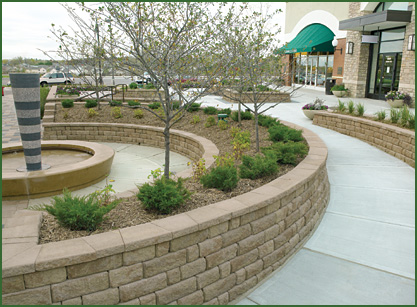 Photo courtesy of Anchor Wall Systems[/caption]
Concrete block has long been a popular and reliable building product for homes and buildings across the country. Now, block — or the concrete masonry unit (CMU) — is getting an aesthetic makeover, jumping aboard the green movement and finding its way into fast-install, mortarless systems.
"Concrete masonry is a time-proven building system that is just as valid and economical as it ever was, with a greater versatility in appearance and design functionality than every before," says Bob Thomas, VP of engineering and research for the National Concrete Masonry Association (NCMA) in Herndon, Va.
Same strength, new look
Architectural appearances of block continue to evolve. Thomas says manufacturers are "tumbling" blocks or using other techniques to chip away at the blocks, making them look aged. Manufacturers also have started stamping the face, so the blocks aren't perfectly smooth, opening the door to different appearances.
"It's all about aesthetic features and looks," Thomas says.
Trenwyth Industries in Emigsville, Pa., offers a popular glazed block, Astra-Glaze, that has the glazing compound cured and heat-treated in kilns, says Carolyn Beach, Trenwyth marketing manager.
[caption id="attachment_10351" align="alignright" width="300"]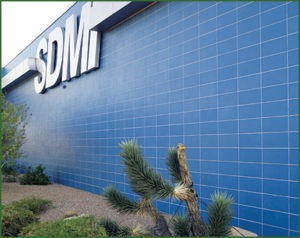 Photos courtesy of Trenwyth Industries[/caption]
"Glazed block has a unique quality in that it has a tight, impervious surface that naturally resists mold and moisture," Beach says.
The company strives to use local aggregates in its block to give it a local flavor. "We make our blocks so they're indigenous to the area," she says. "The aggregates in the block in your building blend into the area."
Some geographic regions favor certain types of block, says Kevin Cavanaugh, commercial masonry specialist for Atlanta-based Oldcastle Architectural Inc., the parent company of Trenwyth. In the Southwest, particularly Arizona, fence block is popular. In Florida, stucco-grade block is the norm.
"It is hard to say which blocks are most popular," Cavanaugh says. "Standard, gray eight-inch and 12-inch [blocks] and their splitface counterparts are very popular, because they provide an excellent value. Also providing an excellent value are half-high, multi-pigmented smooth units used in single-wythe walls."
These units, installed with gray mortar, look like traditional brick and block cavity walls.
[caption id="attachment_10352" align="alignleft" width="300"]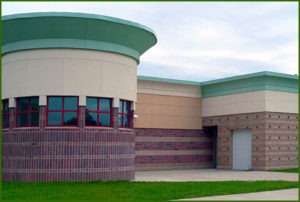 Photo courtesy of Oldcastle Architectural Inc.[/caption]
In November 2007, Oldcastle launched Quik-Brik, an eco-friendly concrete masonry veneer the company calls a "CMU alternative." The new V-Brik design has the top web surface angled toward the center of the unit.
"The V-Brik design enhancement will offer more control over water leakage and assist in mold prevention, while continuing to offer our customers a durable, cost-effective, single-wythe wall system with the rich look of traditional brick," says John Kemp, senior VP of marketing for Oldcastle. "It is a terrific green option that meets the needs of both commercial and residential specifications at a 20 percent to 30 percent cost savings versus traditional brick veneers."
Recycled materials equal green blocks
Concrete block that uses recycled materials is becoming trendy. Commonly recycled aggregates include crushed concrete block, crushed concrete, by-product aggregates and glass.
[caption id="attachment_10353" align="alignright" width="200"]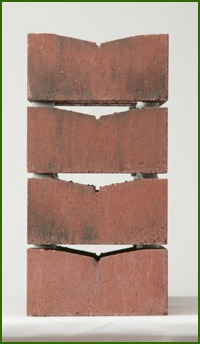 Old Castle's V-Brik[/caption]
"There are places all over the country that are using more and more recycled materials in block," Thomas says. The block still has to comply with the same industry standards as traditional block.
Old Castle's V-Brik[/caption]
"There are places all over the country that are using more and more recycled materials in block," Thomas says. The block still has to comply with the same industry standards as traditional block.
NCMA is opening a research-oriented facility May 15 in its Herndon office to perform small production runs that simulate typical mass-production facilities. The laboratory will perform tests on concrete products, including recycled materials, to determine their compliance with industry standards and customer specifications.
Currently, Oldcastle offers several blocks, both regionally and nationally, that contain recycled content, Cavanaugh says.
"Green products of all types, including CMU, are definitely becoming more popular as our national and global sustainability concern grows ever larger," he explains. "Some large builders require minimum amounts of greenness and are setting their own standards, independent from [the U.S. Green Building Council] and [Leadership in Energy and Environmental Design] benchmarks."
Azar Mortarless Block Inc. in Tecumseh, Ontario, Canada, is working on an environmentally friendly block that uses post-consumer recycled glass, says Glen Ross, director of marketing and sales for Azar. He expects the block to be available later this year.
"The blocks are 10 pounds lighter, so it's easier for the guys lifting them all day," Ross says. "They also have a higher R-value, so the walls need less insulation."
Azar currently offers a dry-stack block that's comprised of a stretcher, full corner and half corner. The blocks can be interlocked horizontally and vertically.
Concrete block walls are striving for a higher R-value. Thomas says a growing awareness of energy conservation is prompting manufacturers to consider block designs that insulate better.
"There is more demand for energy conservation," Thomas says. "The thermal mass of concrete masonry makes it an energy-efficient building material, but owners and specifiers are influenced by R-value ratings. This results in increased interest for unit configurations and masonry systems that integrate insulation with reduced thermal bridges."
[caption id="attachment_10355" align="alignright" width="300"]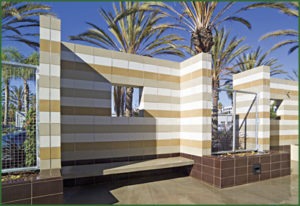 Photos courtesy of Trenwyth Industries[/caption]
Fast, easy installation systems
Designing and manufacturing mortarless block systems that allow for quick and easy installation is an ongoing trend. The systems let masonry contractors use less-skilled labor for projects.
Minnetonka, Minn.-based Anchor Wall Systems Inc. designs and licenses dry-stacked retaining and free-standing wall systems, says Nancy Johnson, channel marketing manager for the company. A lip along the back of the block keeps each course aligned and provides the necessary setback. The company's new Anchor Highland Stone features earthen colors, rounded edges and rough-hewn textures.
"We found that, for masonry contractors, installing the block requires a far lower skill set — a different skill set — than what they're used to," Johnson says. "Dry-stacked walls are easier and faster to install. You can build a nice wall in less time and with a less-skilled crew."
Azar also has a system that allows masons to quickly stack block over a level first course, Ross says, noting that contractors can save money by using one or two masons to set the block, then using non-skilled labor to carry the materials.
[caption id="attachment_10356" align="alignleft" width="300"]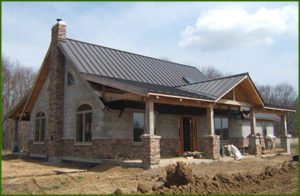 Photos courtesy of Azar Mortarless Block Inc.[/caption]
"The savings are in the time," he says. "In the amount of time it would take you to do 250 to 400 blocks, you could easily do 600 of our blocks."
Mortarless block appears to be gaining in popularity because of advancements in built-in interlocking systems, Thomas says, adding that the ultimate success will depend on profitability.
"The only way mason contractors will invest in the cost of purchasing interlocking block is if they find a way to make money out of it," he says. "If it's a win-win for them, then they are likely to figure out how to incorporate it into their projects."
[caption id="attachment_10357" align="alignright" width="300"]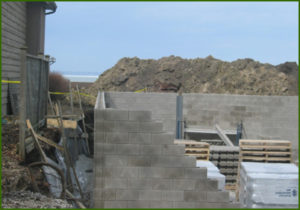 Photos courtesy of Azar Mortarless Block Inc.[/caption]
Mortarless block systems also give masonry contractors a greater variety of products to offer clients, Johnson says.
"New technology allows you to get a lot of looks or faces," she says. "If I'm a mason, it gives me a range of offerings for my customers. All that this does is it says, 'I don't have to sell high-end jobs every day of the week.'"
Ross says mortarless systems are being embraced in all geographic regions and will gain a greater market share. "I honestly feel it's the block of the future," he says.
Side Story:
Brett Martin is a Minneapolis-based freelance writer with 15 years of construction and writing experience.