Keeping the Faith
Words: Dan Kamys
REHAB & RESTORATION
CASE STUDY: Mast Climbers
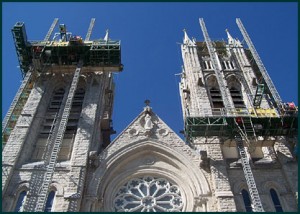 The Church of Our Lady of Immaculate Conception in Guelph, Ontario, underwent a three-year restoration that expected to cost $10 million. The 120-year-old gothic-style church is more than a place of worship and a designed National Historic Site; it is recognized as a landmark by the whole region and, therefore, had to stay open during refurbishment.
Among the contractors bidding for this three-phase restoration contract was Limen Group Ltd., a company that has been around for three generations and counts among the largest masonry contractors in Ontario. Joe Lima and his team knew exactly how to present the best bid and win this contract. The group contacted their access equipment dealer, Du-For, and with the help of Beno”t Duplessis and Sylvian Cloutier, came up with a solution combining Hydro Mobile mast climbers with swing stages and tubular scaffolds.
"I think there are several reasons why Limen Group got this contract," says Sylvain Cloutier, Du-For. "First of all, their estimate was about $75,000 below the price of those of the other bidding contractors, mainly because Hydro Mobile's mast climbers cut down installation time and increase workers' productivity. On top of this, while traditional scaffolds would have required shore poles to be installed inside the church's roof to support the load, mast climbers did not even touch the fragile roof. Finally, the diocese was delighted to learn that, with this method, the church's facade and painted ceilings would remain visible during renovation."
Jason James, manager of the restoration division at Limen Group Ltd., explains further advantages of mast climbers for renovation works. "The first benefit of mast climbers on a renovation job is that they require fewer bolt holes than traditional scaffolds. The platforms allow access to every square foot of the building's exterior, even to the narrowest corners. Finally, the work area is much larger, and the work environment is, consequently, much safer."
Overall, with mast climbers from Hydro Mobile's M-Series, the entire renovation method was revolutionized. This model measures seven feet wide, is up to 60 feet long and carries 22,000 pounds. Workers can easily remove the stones from the facade, using Hydro Mobile's hoist system for heavier pieces, and then land them on the work platform where a workshop and tools have been preinstalled. They can clean and cut the stones directly on the decks before finally replacing them without effort. Additionally, thanks to the weather protections and heaters installed on the platform, work can be performed year-round, even during the harsh winters in Ontario.
Limen Group Ltd. was the general contractor for this project and had 45 workers on the job, including sub-contractors. The company used a total of 13 mast climbing work platforms from Hydro Mobile, and rented this equipment to a few subcontractors. Seven M-Series were used for their high capacity and two P-Series were used to access the most restricted locations. Four F-Series were used for their versatility and because they can operate in split mode. This allowed Limen Group to bring one side down to load material, while the other side stayed above the church's roof.
For more information, visit www.hydro-mobile.com.
CASE STUDIES:
— Color Blending Masonry: Henry Medical Center Facility Expansion
— Flashing: TotalFlash in Action
— Mast Climbers: A New Nashville Skyline
— Mortar: Rising to the Challenge
Side Story:
Return to Table of Contents