July 2008: Full Contact Project Management
Words: Dan Kamys
Full Contact Project Management
Lessons From T-ball: Overcoming Fear
 By "Coach" Gary Micheloni
Life is designed so that we continue to grow. That's the natural order of things. Little kids grow up, and big kids are supposed to become adults. As we get older, we usually become wiser and should become more skilled, at least that's the theory. But some people stop growing, for different reasons.
In construction, we expect that all of our field people will continue to improve. But, sometimes, the growth just stops. So, the question that must be asked is, "Why?" Could it have something to do with fear of success? Fear of failure? New insight actually came to me while watching, of all things, a T-ball game.
|
|
| Coach Gary says:
Don't let your egos get in the way of a free education."
|
|
|
|
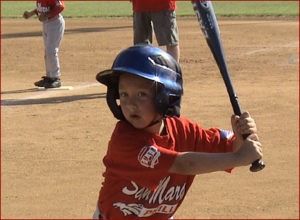
Fear keeps some of us from growing. But I learned a simple lesson or two on overcoming fear, just by watching a game of fearless, pure baseball, as practiced and played by a group of first-graders.
Think about the parallels between you and a T-baller. What does a first-grader worry and think about?
- Family in the stands, even though Mom and Dad are cheering him on to victory
- Knows his teammates are counting on him, and doesn't want to perform poorly and embarrass himself
- His coaches, and how to satisfy them
- Getting invited to Freddie's birthday party next week after the big game
- Above all, not getting to first base.
 What about our rookie PM, on his first day at the new job?
- Family has high hopes for this promotion
- Brand new "team" is counting on him, and PM doesn't want to embarrass himself by not performing
- His boss is expecting great things
- Fitting in with all of the office politics and its social scen
- Striking out and not even getting close to first base.
How does the T-baller overcome his fear of hitting? Let's look closely at this.
- He hits off a "tee" when he is first learning the game. For those unfamiliar, picture a baseball tee as a three-foot golf tee that the baseball sits on, stationary, so the batter can hit it. No fastballs, high, hard and inside. No brush-back pitches. First half of the season, everyone hits only off of the tee.
- Second half of the season, the player gets a few swings at a ball tossed softly by his coach. If he doesn't connect on any of these three pitches, he hits off the tee. Most of the kids miss the coach's pitches, and have to go back to the tee. Part of the game, no embarrassment.
- Next season, as a second-grader, there is no tee, but just "coach pitch." Soft tosses to a kid who now has better hand-and-eye coordination.
- Season three, our third-grader finally faces an opposing pitcher, but only after a couple of years of practice.
|
|
| Coach Gary says:
"A Major Leaguer will get a hit about once every four at-bats. A really good hitter will only hit about one in three."
|
|
|
|
In T-ball, you can't strike out. You will hit the ball. The worst you can do is to hit the ball somewhat and run for first base. The only way to fail in T-ball is to not play the game, to quit and never get up to bat. How sad is that?
Let's look now at our rookie PM who has the title, but has never practiced, never grown. How does he learn the game?
- He tees it up, too. He has studied the game and knows that certain issues present themselves as absolute gimmies: The architect sends out a bulletin and notes a change to the plans and specs. All our batter has to do is put it on his "tee" by writing an RFI and saying, "It's not ours. What should we do?" And the architect/CM will have to ask him to price it out. It's a hit!
- Many times, the opportunities are not that easy, but are still like a slow-pitched softball. Like when you suggest a substitution or maybe some value engineering, and your company picks up a little extra for the bottom line. An easy hit.
- After a while, you begin to get a little confidence. The next time the project superintendent asks when you are going to do such and such, you write an RFI explaining that "such and such" is not in your scope of work, because it is not in either the contract or the project specs. Wow, a stand-up double!
- Now that you've gotten a little experience, you'll be able to tackle even more challenging issues. Maybe the issue isn't really clear cut or black and white, but you take a shot at it anyway. Sometimes you win, sometimes you don't. But you are always excited to take your turn at bat. And, you'll get your fair share. You'll at least get to first base.
Good hitters get that way by becoming students of the game, working with the coaches and practicing the craft. Project managers do the exact same thing, even if it means studying under a first-grader.
| Coach Gary's Corner:
This is the year to lead your team. Start by getting some coaching to deal with the changes that crop up on every jobsite. Get Coach's free course on Winning RFIs. Go to the Web site, www.FullContactBlog.com. Check out the free audio updates and other info that will help your projects. Also, you can get Coach Gary's book "Get Paid for a Change!"
|
|
Gary Micheloni is a working project manager, speaker, author and consultant. Got a question? Go to the Blog and ask him.
Copyright 2008 Gary Micheloni
Return to Table of Contents