Linking Permeability, Durability and Sustainability
Words: Dan Kamys
Sustainability
By Kevin Yuers
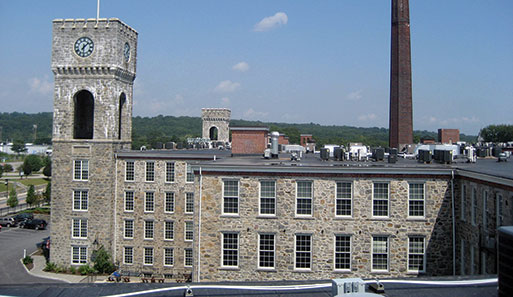
With sustainability in mind, integral crystalline concrete waterproofing products were used to restore this 110-year-old mill. The Royal Mills restoration was the winner of the 2010 New England ICRI Project of the Year.
With an increase in the residential building market forecasted for 2014, the demand for concrete across North America is expected to follow suit. Extensive evidence shows us that concrete structures around the world are not meeting their designed service life, due to rapid deterioration – all of which is caused by the transport of fluids and moisture through the concrete. Concrete structures have traditionally had a design life of 50 to 100 years. Unfortunately, many of today’s structures are not living up to expectations.
Much of the concrete infrastructure currently in service across North America is badly in need of repair or replacement in as little as five to 10 years after construction. This premature deterioration is at a huge cost to owners, taking precious financial resources away from planned infrastructure growth, or other local initiatives that could involve both private and public spending in more productive ways.
Sources of concrete deterioration
Water is the main source of premature deterioration. It is concrete’s ultimate aggressor, directly corroding the surface of concrete, but also by carrying chemical contaminants deep into the concrete structure.
Contaminants such as salt will corrode the steel reinforcement within the structure, and can be introduced through water or moisture carrying them through capillary pores within the concrete. Sulfate contaminants, alkali reactive aggregates, and water can cause disruptive expansion, once absorbed by the sponge-like concrete pores.
When designing and building a structure, mitigating water ingress through concrete is critical to the project’s overall integrity and durability
Permeability, durability and sustainability
|
 |
|
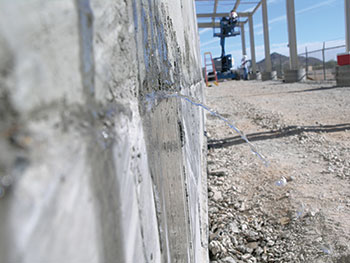
Hydrostatic pressure is a major cause of concrete water problems. |
As the permeability of concrete directly affects the structure’s overall durability, it is critical to mitigate water’s ability to infiltrate through permeability in order to increase durability and, thus, support the sustainability of these types of infrastructure. Sustainability is a concern, now more than ever, with infrastructure expansion and population growth occurring worldwide.
The durability and longevity of a structure directly impacts the environmental footprint that structure creates. By using sustainable practices and materials that enhance the durability of our infrastructure, we are supporting a long-term initiative toward building better, longer lasting cities.
So what choices do we have when selecting a product that will address these concerns? Creating a durable structure is more than just applying a one-size-fits-all solution and forgetting about it. To prevent the destruction caused by water permeability, the immediate and future purpose of the structure – as well as its unique location needs and water infiltration risks – must be carefully evaluated.
If a structure is at high risk of water permeation, selecting the appropriate waterproofing product can greatly reduce the need for costly repairs or premature replacement.
Protecting concrete from water has traditionally been accomplished by separating it with a membrane of some kind. Typically, membranes are applied to the concrete surface either as a liquid coating or as flexible sheets joined together. While they have been used in many projects, these approaches have a few common setbacks:
•???? ??They only attach to the concrete’s surface
•???? ??They are easily compromised by a puncture or separated seam
•???? ??They will eventually break down and need replacement
|
 |
|
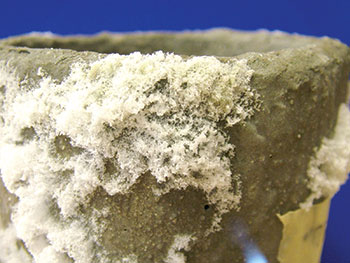
Truly sustainable waterproofing products and systems must support the durability of a structure. Reducing concrete’s permeability mitigates water damage to support longer lasting structures. |
Desirable properties in a sustainable concrete waterproofing solution
To overcome these vulnerabilities, a proven option to reducing concrete’s permeability is to turn the concrete into the water barrier by using a permeability reducing admixture.
Permeability Reducing Admixtures are outlined by the American Concrete Institute’s 212.3R-10 Report on Chemical Admixture as PRAH and PRAN classifications.
PRAH: Permeability Reducing Admixture –
Hydrostatic Conditions
PRAH products reduce water penetration through crystalline growth, can perform under hydrostatic pressure, and are suitable for watertight construction.
PRAN: Permeability Reducing Admixture –
Non-Hydrostatic Conditions
PRAN admixtures reduce water absorption by repellent chemicals (soap, oils) or partial pore blocking (fine particle fillers). These admixtures are not suitable for concrete exposed to water under pressure and cannot protect in the presence of hydrostatic pressure. Waterproofing against hydrostatic pressure is an important distinction that sets PRAHs apart from PRANs.
Many concrete structures that are at the greatest risk of water damage are those that have below-grade levels, and are located near a body of water. Hydrostatic pressure is created when the combination of fluid and soil pressure force water into the concrete itself – sometimes strong enough to break or penetrate surface-applied waterproofing efforts.
Other desirable properties to look for in a sustainable concrete waterproofing solution include:
•???? ??Proven third-party testing and certification
•???? ??Technical support
•???? ??Reduction of waste on the jobsite
•???? ??Reduction of site disturbance
•???? ??No harmful Volatile Organic Compounds (VOCs)
•???? ??A recyclable concrete end product
Consider each of the factors above to determine the true cost of your concrete waterproofing decision. What ultimately will be determined is the overall value – long and short term – that each of your choices would bring to the table. Naturally, the best selection would be the option that gives the best and greatest value to the project at hand. Knowing all of the variables takes the risk out of concrete waterproofing, and is the first step in achieving a durable, sustainable structure.
| Product Watch
Newform Wireholder Rebar Chair
|
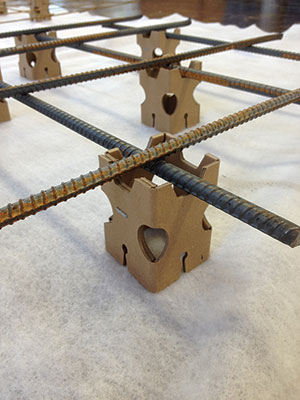 The Newform Wireholder Rebar Chair from Newark Recycled Paperboard Solution is a recycled paperboard product that can be used to lift mesh, cable or wire off the ground, keeping the mesh supported above the membrane before and during concrete pouring. The Newform Wireholder Rebar Chair from Newark Recycled Paperboard Solution is a recycled paperboard product that can be used to lift mesh, cable or wire off the ground, keeping the mesh supported above the membrane before and during concrete pouring.
Used for multiple purposes, one side can be used for wire and, when flipped over, the other side can be used for rebar. Made out of 100 percent recycled paperboard materials, Newark’s rebar chair is the first and only of its kind offering the benefit of being sustainable and allowing contractors the ability to claim the benefits of the Leadership in Energy and Environmental Design (LEED) credit. Current solutions consist of plastic, metal or concrete.
Capable of holding more than 410 pounds, the chair’s modest appearance hides ample strength and has a sturdy stable design, allowing wire to be held securely in place. Its large base provides maximum resistance to being depressed into soft sub-surfaces, permitting it to be effectively used on sand or soft fills.
|
Return to Table of Contents