December 2013: Government Affairs
Words: Dan Kamys
Government Affairs
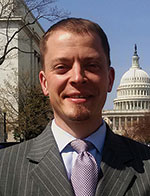 By Stephen A. Borg
As written about earlier this year, one of the biggest issues that the Mason Contractors Association of America (MCAA) has been watching in Washington, D.C., for the last decade has finally come to a head: The Occupational Safety and Health Administration (OSHA) officially printed their new workplace silica exposure rule in the Federal Register on Friday, Sept. 13, 2013, setting in motion the procedure of collecting public comments, holding public hearings on the proposed rule, and moving toward releasing a final rule.
As a result, the MCAA has joined together with more than 20 other construction industry trade associations to form the Construction Industry Safety Coalition (CISC) – the goal of which is to work together as a unified construction industry to respond to this proposal and to seek a feasible and cost-effective crystalline silica regulation that improves safety and health protection measures for workers. CISC has held numerous all-day conferences to review the rule and its potential impacts on the construction industry, weekly conference calls, and joint meetings with Members of Congress and federal government officials.
As a part of our initial efforts, CISC, along with each separate member of the coalition, sent official letters to OSHA requesting a 90-day extension to all deadlines related to the proposed rule (public comments, public hearings, etc.) and to request that OSHA hold public hearings throughout the nation and not just in Washington, D.C., as the current rule dictates.?? This 90-day extension would provide you, the public, the MCAA, and our partners in CISC more time to read through the very complex and extensive rule and gather the necessary data to be able to respond in a comprehensive and detailed manner.
OSHA recently announced that they have decided to extend the public comment deadline by 47 days, delay the public hearing schedule by only two weeks, and not to convene hearings outside of Washington, D.C. We will continue to pursue efforts to receive the full 90-day extension on all deadlines.
While we continue to study the hundreds of pages of the rule and related documentation that OSHA has released, we urge you to remain vigilant and committed to helping us as we battle to have a voice in this fight. It is imperative that you get involved with this issue, call your Members of Congress, talk to your colleagues and business partners, and contact the MCAA to ask how you can be helpful in our efforts to block or amend this proposed rule. One of the biggest ways you can be helpful in the near term is to officially submit requests to OSHA asking them for the full 90-day extension and to hold public hearings throughout the nation.
The current hearing schedule released by OSHA has the public hearings occurring in Washington, D.C., in early-March 2014. With that date falling right in the ramp up of construction season, it would be nearly impossible for small, construction industry members, such as many of our MCAA members, from flying to Washington, D.C., and participating in these hearings. OSHA needs to hear from those who this rule would affect the most and, with the current schedule, that would be virtually impossible.
We will continue to update you as the rule-making process continues and we update our summaries and talking points on the numerous aspects of this rule. We appreciate your very close attention to this issue and look forward to continuing to work with all of our MCAA members to ensure that our employees remain safe and healthy, while at the same time ensuring that any OSHA rule is based on sound science and is technologically and economically feasible, per federal law.??Please do not hesitate to contact the MCAA at 800-536-2225, if you have any questions on the rule or how to submit official comments to OSHA.