Book Smart Masons: The Wave of the Future
Words: Dan Kamys
Education
By Steven Fechino
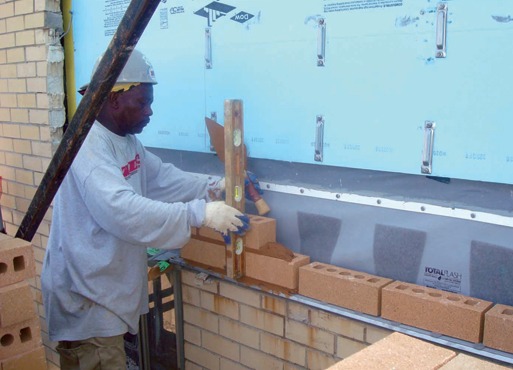 Installation of Total Flash at Asbury Towers
Masonry is an industry that has endured the test of time. Education within this industry will continue to evolve as new products, equipment and designs create the need for updated training for our apprentices and journeymen.
The National Center for Construction Education and Research (NCCER) has been on the forefront of the educational update since 1989, when it published the first series of masonry textbooks for the training of secondary and post-secondary students. NCCER is a not-for-profit 501(c)(3) education foundation created to fill the need for standardized masonry curriculum. NCCER is recognized by the construction industry, covering more than 70 different disciplines as the training, assessment, certification and career development standard for the craft professional.
NCCER stays current with industry practices. The masonry manual was revised in 1998 and 2004. The latest revision for Level 1 occurred in November 2013, with Level 2 to be completed in May 2014 and Level 3 to be released in late-2014. The masonry curriculum encompasses more than just how to lay bricks and blocks. It goes into detail how to read blueprints; layout; beginning an estimate; introductory and advanced laying techniques; residential and commercial construction practices; grouting and reinforcing walls; metal work associated with the trade; moisture control; crew leader skills; and masonry repair and restoration techniques.
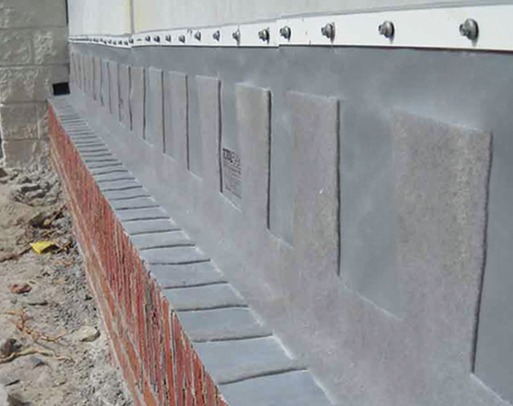 Shown is a long run of Total Flash installed.
Participation in the revision for Level 1, 2 and 3 volumes has spanned the last 1.5 years, whereby the subject matter experts meet in cities across the country for a week each time to cover, discuss and revise the text. The goal is for the text to be as universal as possible for the standardization of the trade terms and methods that will be used for years to come, by both apprentices and tradesmen in the field.
The team that has contributed all of this time consists of many familiar faces within the industry:
- Dennis Neal, Florida Masonry Apprentice & Educational Foundation
- Bryan Light, Brick Industry Association
- Moroni Mejia, Arizona Masonry Contractors Association
- John Foley, M.A. Mortenson Co./Rocky Mountain Masonry Institute
- Steven Fechino, Mortar Net Solutions
- Todd Hartsell, Central Cabarrus High School
- Robert V. (Buddie) Barnes Jr., Dee Brown Inc.
- David Masterson, Dee Brown Inc.
- Jeff Buczkiewicz, Mason Contractors Association of America
- Kenneth Cook, Pyramid Masonry Contractors
- Lawrence Johnson, Skyline High School
- Merritt “Bud” Johnson, Samuel High School
The “Masonry Trainee Guide” has many blocks of information that can be useful to even the most seasoned mason contractor. A brief overview of the information contained within each chapter is as follows:
- Blueprints – basics for the beginner learning to read a set of residential or commercial drawings. Allows the student to recognize and calculate areas, understand basic specifications and learn how to read a mason’s rule.
- Layout – provides the student the ability to convert the engineering decimals to feet and inches, correctly layout 90-degree corners, operate a builder’s level and other automated leveling devices, properly record site data, and perform distance measurements across long, uneven distances.
- Estimating – these concepts are found in several levels of the text, and information ranges from understanding basic terminology and abbreviations; understanding basic details; and estimating procedures for determining quantities for bricks, blocks, mortar and metal accessories.
- Introductory Laying Techniques
- Advanced Laying Techniques – teaches the student how to understand the basic structural principals of a wall and fundamentals for different types of walls. Control joints, expansion joints, reinforcement and bonding techniques are discussed. Arches and arch layout are discussed in this module for the more advanced student.
- Residential Module – includes information on building steps and chimneys as well as many of the requirements for residential construction.
- Commercial High Rise Construction Practices – describes the different equipment associated with multi-story construction. Safety equipment is covered as well as safety procedures associated with this specialized craft. Safe material handling and high-rise lifting hand signals are diagramed for a quick understanding and reference for the student.
- Grouting and Reinforcing Walls – covers typical ingredients and properties of grout, different grouts used in various applications, admixtures, and methods for placement of rodded, low-lift and high-lift grout.
- Metal work associated with the trade – an important module as it covers non-masonry laying skills that are important to the advancement of a mason. Installation of lintels, shelf angles and the different functions are reviewed. Setting of hollow metal door frames, embedded items, anchors, fasteners and vertical reinforcement are described in this module.
- Moisture Control and Bracing – discusses the requirements for flashings at masonry openings, installation techniques for material placement around windows and doors, intersecting wall construction, and bracing requirements and bracing methods.
- Crew Leader Skills – presented for the mason who needs the exposure to the organization and structure of this industry. This module will show the planning and scheduling of a project, while sharing an understanding of communication, motivation, leadership skills and jobsite safety awareness.
- Repair and Restoration Module – discusses how to evaluate masonry deterioration, how to understand basic causes for the failures and repair techniques, the correction of efflorescence and faulty mortar joints, and repair procedures for rebuilding fireplaces.

The masonry trade is different today than it was when most of us began with a shovel and a wheelbarrow. I personally had mentors teach me many of the useful tasks that allowed my interest to grow and my living to be made in this trade.
The NCCER has developed a textbook that can offer the student a wealth of information and provide an accredited program that is nationally accepted as a standard for the industry. The NCCER Level 1, 2 and 3 manuals are accurate and up-to-date sources of information that can benefit the most seasoned contractor or school instructors with the desire to develop masonry professionals.
Return to Table of Contents