August 2013: Making the Grade
Words: Dan Kamys
 Making the Grade
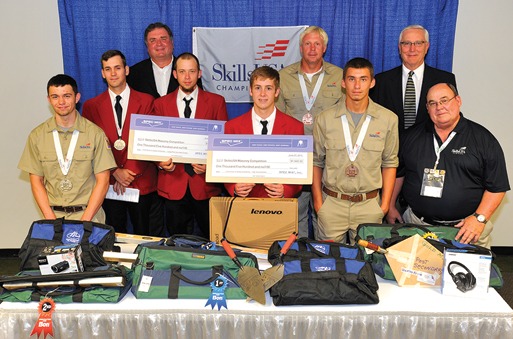 Shown left to right are second place-winners Steven Quimby and Travis Moore; first-place winners Brent Austin and Andrew Mullis; and third-place winners Mark Karhoff and Chase Smith. Among the adult sponsors of this event were (on left) Bill Kjorlein, Argos USA; (on right) Bryan Light, BIA SE Region; and Al Herndon, Florida Masonry Apprentice and Education Foundation.
Companies and organizations of the masonry industry joined together in June to support the 49th Annual SkillsUSA National Leadership and Skills Conference and the National Masonry Contest.
For up to six hours, 46 young masons from 33 states competed at H. Roe Bartle Hall in Kansas City, Mo. Each contestant, using three types of block and three types of brick, tried to construct the winning project by placing the masonry materials and mortar exactly in accordance with the plans.
The 2013 winner of the post-secondary/college competition was Brent Austin, 20, from Central Cabarrus High School in Concord, N.C. Austin’s instructor is Todd Hartsell. The 2013 winner of the secondary/high school competition was Andrew Mullis, 18, from South Rowan High School in China Grove, N.C. Mullis’ instructor is Rodney Harrison.
Each first-place winner received a $1,500 scholarship check from Spec Mix. All six medal winners won tools, engraved trowels, boots, computers and digital cameras – all donated by supportive contest sponsors.
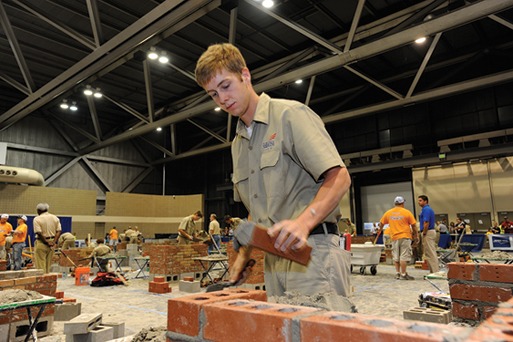 Andrew Mullis finished first in the secondary/high school division.
Masonry competitors were part of more than 6,000 students who competed in 104 different career trade, technical and leadership fields. All of them state contest winners, the contestants effectively demonstrated their expertise in the occupational skills required for such trades as electronics, computer-aided drafting, culinary arts, carpentry, plumbing and masonry.
During the final evening, the awards ceremony was held at Kemper Arena in front of a crowd of more than 15,000.
Student interest in masonry vocational training continues to be strong. This year, 31 high school and 15 post-secondary/college contestants competed in two divisions.To qualify, the students had been winners, or designated second-place finishers, of their own state contests. They competed against the clock and against themselves to demonstrate their expertise in masonry.
The contest consisted of a written test and the construction of a brick-and-block composite project. The project for the contest was designed by Bryan Light of Brick Industry Association, SE Region, to test the skills needed for successful entry into the masonry profession. Bryan Light has served as chairman of the technical committee since September 2003.
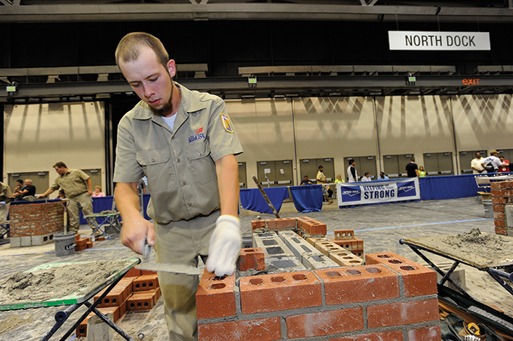 Brent Austin works to complete his composite brick-and-block project.
Trade professionals from Bricklayers Local #15 and selected vocational instructors judged the projects by taking extensive measurements, measuring plumb at six locations, and judging finishing techniques and overall appearance.
New members of the National Masonry Technical Committee and welcomed sponsors of the contest were National Center for Construction Education and Research (NCCER) and Oldcastle Architectural. The sustaining members and sponsors of the contest included Argos USA, Bon Tool Co., Brick Industry Association, BIA Southeast Region, EZ Grout Corp., Marshalltown Trowel Co., MCAA, Multiquip, NCMA, and Spec Mix.
This year’s contestants were supported by donations and services from Spec Mix, Multiquip, Oldcastle Architectural, Glen-Gery Brick, Midwest Block & Brick, and the NCMA. The tour was followed by a luncheon in honor of the contestants and their instructors. Steve Green, VP of the NCCER, spoke to the contestants during the luncheon.
??Return to Table of Contents