October 2012: Full Contact Project Management
Words: Dan Kamys
 Full Contact Project Management
By "Coach" Gary Micheloni
Full Contact Project Management
By "Coach" Gary Micheloni
When Neil Armstrong died recently, it seemed like a part of me died with him. It is so hard to believe that he is gone – the man who first walked on the moon some 42 years ago, when I, along with hundreds of millions of my closest friends around the world, watched it all unfold.
Nations around the globe rejoiced and celebrated. Why? Everybody wanted to be a part, and the way that America went about it was extraordinary. The United States did not “claim” the moon. Instead, consider the plaque our guys left on the surface of the moon, attached to the leg of the landing module, which still remains there:
Here men from the planet Earth first set foot upon the Moon. July 1969 AD. We came in peace for all mankind. [Neil Armstrong read it aloud while standing on the surface.]
The moon landing and the walk took place on July 20, 1969; the landing about 4 p.m., and the step onto the surface of the moon around 11 p.m. EST. In advance of the occasion, President Nixon declared that July 21 would be a national holiday, so that everyone could stay up late, watch and – hopefully – celebrate. And we did!
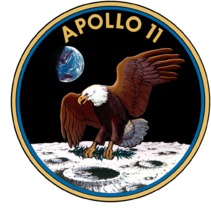 The space program has long been celebrated in this country. People honored the heroism of the astronauts, sure, but also applauded the sheer ingenuity and resourcefulness of its engineers, scientists and technicians, along with the military that assisted in recovery at sea of the capsules as they returned to earth.
And, all of this was accomplished with computers that were bigger than a house, yet had far less capability than the smart phone you carry in your pocket today. Put another way, NASA basically ran the program with the equivalent of a pocket calculator and a bunch of very smart and dedicated people.
Successes are great. Failures along the way are almost inevitable, and always painful. Not only did the United States lag behind the Russians for the first few years of the Space Race, but we had some horrible losses as we traveled that road to the moon. We would have a rocket blow up as it was attempting to launch a small satellite, then figure out went wrong, fix it, and launch again. Sometimes there were multiple failures in a row. But things always got figured out, fixed and made to work. Plans get modified, goals don’t.
|
Neil Armstrong Said:
That's one small step for man, one giant leap for mankind.
|
|
|
In order to have an Apollo 11 as your goal, the plan had to begin with an Apollo 1. As that crew was sitting in its capsule training, a fire broke out in the cabin, and all three men were killed. I still can take you to the exact spot on the road where I was when I heard it first. But the plan was adjusted, somewhat because of circumstances, not the goal. Never the goal!
Not everyone reading this article today was around to see Armstrong and Buzz Aldrin walk on the moon in 1969, but most of you can recall the horrible days in 1986 when the Shuttle Challenger blew up, right after launch, and in 2003, when Columbia broke up on reentry after completing most of her mission.
|
Neil Armstrong Said:
Houston, Tranquility Base here. The Eagle has landed.
|
|
|
Most worthwhile projects require that element of “team” in order to execute the plan and accomplish the goal. What about you and your big goal? We all know the old saying, “If you fail to plan, then you plan to fail.” A business, like a plant, is a living organism. It either grows or dies.
The MCAA is not quite a space program, but they are a lot like an aircraft carrier. When you are low on gas, you can land there, get a meal, become refreshed, get the fuel you need, get some training and maybe get a new flight plan. Just know that they have a catapult ready to help you take off again.
| Coach Gary's Corner:
What’s your plan for Independence in 2012? Coaching will help you get there in less time, and with more success. Ask Coach Gary to speak for your group, association or convention, or even to coach your company. Coach Gary’s first book, “Get Paid for a Change!” is available at Amazon.com. Pick it up there; change your business. And, get his FREE scheduling seminars at?? www.MicrosoftProjectClasses.com.
|
|
Return to Table of Contents