Keeping Pittsburgh Tunnels Up and Running
Words: Dan Kamys
Case Study: Rehabs and Restorations
Shotcrete MS allows crews to repair damaged areas, keeping Pittsburgh tunnels open for commuter traffic
Connecting Pittsburgh to its southern hills, the Liberty Tunnels serve as one of the major arteries to the city, eliminating the need to travel over or around Mt. Washington. Before the tunnels, traveling around the mountain made commuting between the south suburbs and the city a long, impractical and dangerous drive.
After 85 years of heavy traffic, wear and tear, the pair of 5,899-foot-long, two-lane tunnels were in dire need of structural repairs and restoration. The rehabilitation was necessary to keep this connecting throughway open for the more than 63,000 commuters who depend on the subterranean roadway every day.
Finding a way
PennDOT, which oversees the tunnels, turned to Pittsburgh-based Mosites Construction Co., a company with a key focus in specialized concrete structures. The time constraints for completing the project were challenging. With the high volume of daily traffic, long-term closure was out of the question. This gave workers an eight-hour window – from 10 p.m. to 6 a.m. – to move all their equipment in, do their work, clean up and move out before the morning commute. In addition, the crew needed a repair product that would leave little mess in the enclosed space.
Mosites opted to use QUIKRETE Shotcrete MS - AR Fiberglass Reinforced, a single-component, dry-process shotcreting material containing micro silica. QUIKRETE Shotcrete MS - AR Fiberglass Reinforced provides high compressive strength, improved sulphate resistance, high adhesion, low permeability, low rebound and low sag.
To meet additional performance requirements, alkali resistant fiberglass fibers were added to control shrinkage cracking, and a migrating corrosion inhibitor was added for corrosion protection of embedded steel reinforcement. Both were blended into the mix during the manufacturing process.
“The limited window of time and constricted working space in the Liberty Tunnels created difficult conditions,” says Dennis Bittner, QUIKRETE regional sales representative. “Shotcrete MS - AR Fiberglass Reinforced was the ideal solution, because it allowed for an extremely quick cure time between applications with little-to-no dust creation.”
QUIKRETE Shotcrete MS is designed for structural and cosmetic repairs to bridges, tunnels, parking garages, ramps, beams, piers, sewer pipes and dams. The material has extremely low rebound and is ideal for vertical or overhead applications. Shotcrete MS is available in both dry-process and wet-process formulations.
Implementation of a solution
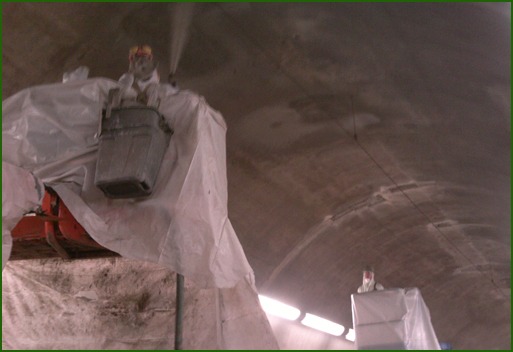
After prepping the area using hydrodemolition and cleaning exposed rebar, workers cleaned the substrate and moistened it to a saturated surface-dry (SSD) condition. Reaching up to 26 inches thick in some sections of the project, the shotcrete was applied with an Allentown PD1-GRH 610 gunning rig with a 750-cubic-foot per minute compressor.
Crews added a temporary sealer, which was removed after the initial layer cured. Then, a flash coat of shotcrete was applied at depths of one-half-inch to 1-inch, to give the top layer the smooth appearance of a gun finish and an appropriate texture to receive a waterproof topcoat.
PennDOT extended the project by 76,000 square feet of shotcrete flash coat, based on the performance and appearance of the QUIKRETE Shotcrete MS - AR Fiberglass Reinforced and the craftsmanship of Mosites. Starting in September 2009, the total amount of QUIKRETE Shotcrete MS - AR Fiberglass Reinforced used on the project exceeded 12,000 cubic feet by the time it reached completion in December 2010.
The QUIKRETE Companies is the largest manufacturer of packaged concrete and cement mixes in the United States and Canada, and an innovative leader in the commercial building and home improvement industries. For additional information, visit www.QUIKRETE.com, or call 800-282-5828.
Return to Table of Contents