August 2011: Making the Grade
Words: Dan Kamys
Making the Grade
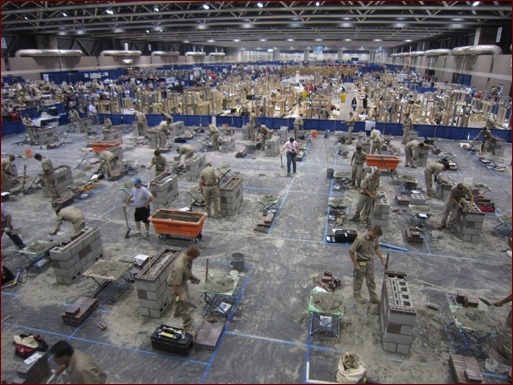
Companies and organizations of the masonry industry joined forces in June to support the National Masonry Championships, which were held in conjunction with the 47th Annual SkillsUSA National Leadership and Skills Conference.
For up to six hours, 50 young masons competed at H. Roe Bartle Hall in Kansas City, Mo. Each contestant, using blocks, bricks and mortar, tried to construct the winning project by placing the masonry materials, according to plans, on a concrete block base.
The 2011 winner of the post secondary/college competition was Dylan Ennis from Midland, N.C. Ennis’ masonry instructor is Todd B. Hartsell, who has trained national contestants in nine of the last 11 competitions.
The 2011 winner of the secondary/high school competition was Jordan Zook, representing Berks Career & Technical Center East in Oley, Pa. Zook’s instructor is Michael Kern.
Student interest in masonry vocational training continues to be strong. This year, 35 high school and 15 post secondary/college contestants competed in two divisions. The student masons qualified for the national contest by winning, or being designated second place finishers, of their own state contests.
Contestants competed against the clock and against each other to demonstrate their technically developed skills. The contest consisted of a written test and the construction of a brick-and-block composite project that was designed by Chris Sutherland, masonry instructor at Pinellas Technical Education Center in St. Petersburg, Fla. Sutherland was the winner of the 2002 SkillsUSA National Masonry Contest.
Brian Light of Brick SouthEast, a Brick Industry Association (BIA) affiliate, has served as chairman of the masonry technical committee since September 2003.
“Chris’ plan tested the ability of the student masons to follow a unique design with a bit more difficulty than usual, while using fewer actual units (brick and block),” says Light of Sutherand’s design. “I’m happy with the results, and so were the instructors in attendance.”
Trade professionals from Bricklayers Local #15 and selected vocational instructors judged the projects by taking extensive measurements, measuring plumb at six locations, and judging finishing techniques and overall appearance.
“Quality products, properly utilized by a well-trained workforce, contribute to excellence in brick-and-block construction,” Light says. “In supporting a contest like this, we show our understanding of the importance of technical training.”
A group effort
Through the efforts of the Brick Industry Association and the National Concrete Masonry Association (NCMA), this year’s contest was supported by the donation of brick from Endicott Brick and block from Midwest Block and Brick. Spec Mix donated 300 bags of cement, and their salesmen mixed the cement and “slung the mud” in support of the aspiring masons.
Members of the National Masonry Technical Committee and other sustaining members and sponsors of the contest included Bon Tool Co.; BIA, the national office and southeast region; EZ Grout Corp.; Hanley-Wood LLC; LaFarge NA;?? Marshalltown Co.; Mason Contractors Association of America; Masonry Institute of Tennessee; NCMA; and Spec Mix.
Other highlights of the annual conclave included a field trip to a local block plant arranged by NCMA representative, Harry Junk. The tour was followed by a luncheon in honor of the contestants and their instructors.
NCMA President Bob Thomas gave the luncheon’s keynote presentation, reminding student masons and their instructors of the sustainability, energy efficiency and functional resilience of masonry construction. He challenged the contestants to pursue excellence, to visualize the attainment of their goals, and to invest in themselves and their industry.
Masonry competitors were part of more than 5,000 students who competed in 94 different career trade, technical and leadership fields. The contestants effectively demonstrated their expertises in the occupational skills required for such trades as advertising, carpentry, electronics, plumbing, precision machining, technical drafting and masonry.?? During the final evening, the awards ceremony was held at Kemper Arena in front of a crowd of more than 15,000.
The SkillsUSA organization represents more than 300,000 students and instructors in the 50 states, Puerto Rico, Guam and the Virgin Islands. The event will be held annually in Kansas City, Mo., through 2014.
Return to Table of Contents