Insight: The Mast Climber Industry
Words: Dan Kamys
Mast Climbers
Masonry gets the straight scoop from Premier Scaffold Solutions’ Michael Solomon
The best way to gain true insight to the state of an industry and a company is to simply ask.
Masonry spoke with Michael Solomon, national sales manager at Premier Scaffold Solutions, to learn what his company is doing to thrive and survive during this challenging economic climate. Following is what he had to say.
Masonry Magazine:?? How has your company survived such a tough economy?
Michael Solomon: We have had the opportunity to start our new Made in the USA manufacturing company in 2009 in Apopka, Fla. Times are tough, but with our company’s collective experience in the construction industry and mast climbing industry, we have put together a great team and a top-notch manufacturing faculty. We also have introduced our dealer re-rental program, which has helped.
Masonry: What are you predictions for the construction industry for 2010 and 2011?
Solomon: I feel from traveling all over the United States that, by the end of the second quarter, the construction industry is heading toward recovery. By the end of 2010 and into 2011, our industry will be much stronger in all fields.
Masonry: Describe your newest mast climber/new product.
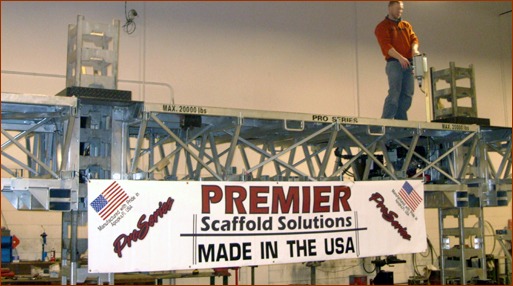
Solomon: We are very excited to unveil the MADE IN THE USA Pro Series unit at World of Concrete in Las Vegas in February. We have worked hard to bring a mast climber to the construction industry that is not only built in the United States, but exceeds all others in the same class.
Masonry: What are your thoughts on mason contractors renting versus buying mast climbers?
Solomon: Having rental equipment, from a dealer perspective, is a must. You must be able to supplement your customer’s needs when those needs exceed their buying power.
Masonry: What would you like to say to our mason contractor readers?
Solomon: Hang in there. The masonry trade has survived many centuries and will continue to get better well into the future, with the help of new products such as ours and new masonry product designs. [With] the pure American desire to build with the best material, masonry will be stronger and larger then ever before!
|
Meet the Pro Series
The Pro Series consists of work platform sections interlocked with a Pro Bar System and constructed of tube steel trusses supported on two steel tower masts. Each tower in cross section has overall dimensions of 16 inches X 16 inches. The towers are assembled from five-foot-long sections that are bolted together. They are supported on a chassis, which has four outriggers, two located toward the building and two on the side of the chassis, opposite the building.
The Pro Series work platforms may be used in a freestanding configuration or in a “tied” mast configuration. The maximum, free-standing height is 35 feet. In the tied mast configuration, lateral struts are installed between the tower mast and the building structure every 20 feet. In this configuration, the maximum tower height is 250 feet nominal. The allowable uniform load for the Pro Series is 20,000 pounds.
The 60-foot-long Pro Series bearing bridge consists of work platform sections constructed of steel trusses and interlocked with the Pro Bar System. The platform interior sections are available in four-foot and eight-foot lengths, while the exterior bearing sections are available in six-foot lengths.
Learn more at www.premierscaffoldsolutions.com. |
Return to Table of Content