Proper Care of Mast Climbers Makes Economic Sense
Words: Dan KamysDecember 2008
Parts & Service

 Keith and Jerry Castle
By Jennie Farnsworth
How you treat your heavy equipment, like a mast climber, can often determine the unit's lifespan. By being proactive and putting in the extra effort, you can add thousands of dollars onto your bottom line.
Masonry spoke with Jerry Castle, president of Jerry Castle and Son Hi Lift Inc. and Bennu Parts in the Chicago suburb of Elk Grove Village, Ill., and his son, Keith Castle, who serves as VP, about how to properly maintain your mast climber work platforms and keep your units damage-free.
Masonry: What scheduled maintenance tasks do mason contractors need to complete throughout the year for their mast climber work platforms?
Jerry Castle: They need to do their daily maintenance: Double-check everything [on the jobsite] and make sure that nothing has settled, that their towers are still level, and look the units over to make sure nothing is wrong. Then, they need to correct any problems they see. First thing in the morning, they need to make sure the ground hasn't settled, the towers are still level and plumb and, if they are using wall ties, that they're still secure, the way they were originally installed.
Masonry: What other annual maintenance tasks are necessary?
JC: Maybe once a year, change the hydraulic oil in the hydraulic system. You also need to check the slides in the older units, and make sure that they're not worn out; if they are worn out, then they need to be replaced.
Masonry: With typical maintenance and repairs, could these mast climbers last for quite a bit of time?
JC: Definitely. A well-maintained mast climber could easily last 20 to 40 years. I mean there's just nothing there that can go wrong if you treat them right. They're made to last. However, if anything gets bent ??? the struts, angles or the platforms ??? then that should be cut out and re-welded with a welder who is certified and knows what they're doing.
Masonry: As the competent person looks over the equipment before it's used daily, what are some telltale signs to look for regarding MCWPs, such as cracks, rust and bent items?
JC: The person needs to look for cracks. Rust isn't as critical as some other signs. When contractors use chemicals to wash the walls down, it can affect the paint on the mast climber and can strip the paint causing rust. But rust isn't the main issue, although over time, it could be a problem. The critical points are that they need to be sure that the towers don't get bent and they are plumb.
Masonry: In your years of providing mast climbing equipment and repairs, what have mason contractors and their crews overlooked in the past?
Keith Castle: They overlook the general maintenance a lot. They don't maintain the motor in them like they should. As long as it starts, they don't really seem to care further about it. They need to do a better job at maintaining them on a regular basis.
Also, when they're handling the scaffold, they need to make sure that when they're carrying it with a forklift, that they do a better job in not bending the scaffolding or damaging the towers. We see a lot of damage due to the forklift operators not watching what they're doing.
Finally, owners just need to make sure they have a competent person who is familiar with taking care of a Honda engine like that on a mast climber ??? how to check the oil, air filter, battery and the regular maintenance that you need to do. As far as day-to-day maintenance, it's just a little Honda engine that runs the whole unit. There's not a whole lot that you need to inspect. Without the engine they're stuck, so a little bit of time and maintenance ahead of time will help out in the long run.
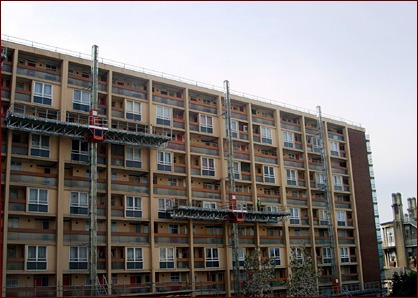 Image courtesy of Fraco
Masonry: At some point you do need to replace a mast climber, typically when repair costs outweigh the expenses of purchasing a new unit, correct?
JC: Yes. Generally that happens when the crew isn't careful and all of the angles, struts and bars are bent or cracked, and you've repaired and replaced all that you can. Then it's time to purchase a newer unit.
Masonry: However, purchasing a newer unit can often mean a faster, safer or easier to use unit?
JC: Yes. For instance, our Continuous Climb has two speeds: A fast speed is 10 feet a minute, with no need to stop, with 12,000 pounds on the unit; then 20,000 pounds, there's a slower speed at 4.5 feet a minute, continuous climb.
The older units have the cylinders that push up several feet, stop and lock, and then you retract the cylinder and are able to go up again.
KC: With so many different languages on the jobsite, you need a simple system to make it as easy as possible for everyone to understand.
JC: Yes, with the new system all you have to do is get up on it, start it, pull the throttle and push one button to go up. And everyone can do that.
Masonry: What has the response been on the Continuous Climb power unit?
KC: It's so simple. People love it.