Maintaining Environmental Sustainability
Words: Dan KamysJanuary 2009
Case Study - Hardscaping
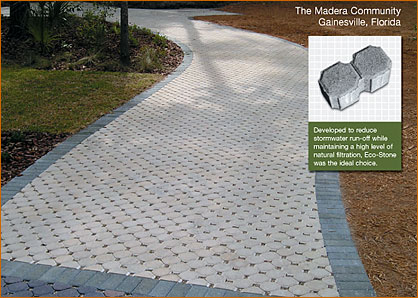
Belgard's Eco-Stone sustained the environment in The Madera Community, a Gainesville, Fla.-based low-impact development.
|
?? |
|
|
The fully wooded, 44-acre site is directly adjacent to the University of Florida campus and consists of 80 lots. In spring 2002, selected builders were invited to participate in a presentation and meeting with the Florida Energy Extension Service, which spearheaded the project for the university and the development partnership. Following that meeting, three participating builders were selected. The homes were designed to be both green and profitable. The first eight homes were to be used as educational and sales tools for prospective buyers and as a vehicle for education and outreach. This would entice other developers and builders to apply these lessons to other projects.
The site design of The Madera Community consisted of a basic low-impact development (LID) strategy for handling runoff by reducing the volume of runoff and decentralizing flows. LID strategies strive to allow natural infiltration to occur as closely as possible to the original area of rainfall. By engineering terrain, vegetation and soil features to perform this function, costly conveyance systems can be avoided, and the landscape can retain more of its natural hydrological function. Within the Madera Community, LID practices dovetail with green building practices that incorporate environmental considerations into all phases of the development process.
The requirements
The design at Madera addressed both of these issues with the following guidelines:
- Planning site layout and grading to natural land contours can minimize grading costs and retain a greater percentage of the land's natural hydrology. Contours that function as filtration basins can be retained or enhanced, and incorporated into the landscaping design. There were two existing low-lying areas that would control 70 percent of stormwater for the entire site. These smaller retention/detention areas allow localized filtration, rather than carry runoff to a remote collection area.

- The topography survey and existing trees drove the site design. The roads and lot locations worked around existing tree groves, creating winding roads and sidewalks. The lots were strategically placed so that the existing tree canopy could be used as shading. Compaction of the earth by the construction vehicles can decrease infiltration by 60 percent to 80 percent.
- Decreasing impervious surfaces can be a simple strategy to avoid problems from stormwater runoff and water-table depletion by reducing surfaces that prevent natural filtration. Reducing roadway surfaces can retain more permeable land area. The street design at Madera helps to limit clearing and compaction with streets that are 20 feet wide, compared to an average residential street width of 35 feet. All roads were designed to existing grade to eliminate the need for both traditional curb and gutter or grass swales, reducing the concentration of stormwater runoff. Shared driveways at Madera helped reduce pavement needs and pervious paving stones have increased infiltration.
- Infiltration storage tank systems can be designed to store rainwater for dry-period irrigation, rather than channeling it to streams. Madera's infiltration tanks hold up to one-third of roof run-off.
- Native landscaping works with pre-existing conditions, particularly climatic. Florida-friendly landscaping emphasizes principles that can create and maintain beautiful lawns and gardens, including having the right plan in the right place, maintaining water efficiency, fertilizing appropriately, mulching and recycling, controlling yard pests responsibly, reducing storm runoff, protecting the waterfront, and attracting wildlife.
Concrete pavers play a part
The Uni Eco-Stone Paving System, designed to reduce stormwater runoff through infiltration, played a significant role in the project. The pavers provide a highly durable, yet permeable, pavement capable of supporting vehicles. They reduce the impact on the environment and stormwater management systems, while recharging local aquifers.
Cost benefits to builders and developers utilizing LID strategies can be significant. According to the Center for Watershed Protection, traditional curbs, gutters, storm drain inlets, piping, and detention basins can cost two to three times more than engineered grass swales and other techniques to handle roadway runoff. Other LID strategies can have similar impact. Choosing permeable pavement for a parking area may remove the need for catch-basin and conveyance piping. Small distributed filtration areas on individual lots can reduce site requirements for larger detention ponds that take up valuable land area.
Return to Table of Contents