University of Washington Baseball Stadium
Words: Isa Stein
Editor’s Note: MASONRY Magazine had the opportunity to talk with Ron Adams, President of Cascade Masonry, about the renovation of the University of Washington Baseball Stadium. In this renovation, Cascade Masonry was the mason contracting company in charge of restoring various rooms and the exterior.
Photos: Cascade Masonry
Masonry Magazine: Tell us a bit about the project.
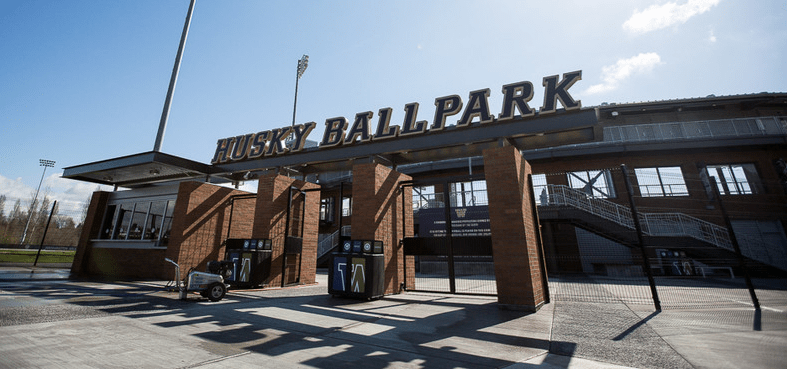
Ron Adams: We were the mason contractor on the job. We were selected by Bayley Construction, the General Contractor on the project. Our work was primarily on the exterior facing non-field side of the stadium with some team rooms and locker rooms.

M.M.: Can you walk us through the construction process?
R.A.: In the design, there was a substantial component of CMU. That was the first structure that we built, and I believe that helped. Part of it was for durability for the team rooms and then part was for, I assume, some structure above for the grandstands and things like that. I think we wrapped some metal columns, if I’m remembering correctly – we’re going back in history so it’s been a while. There was some CMU structure done that was all covered with a brick veneer.
M.M.: How long did this project take?
R.A.: We were on site for approximately four months. The overall job had a very tight time constraint because it had to happen from the time baseball season ended, but then had to be ready to go for when the baseball season opened. It was a very time constrained job to be able to get everything done in a short period of time.
M.M.: What type of materials were specified for this project?
R.A.: We used structural 8” and 12” CMU for most of the structure, and then modular brick veneer was used on the exterior from Mutual Materials.
M.M.: Did you face any challenges during the project? If so, how did you overcome them?
R.A.: The project overall was a tight building site because it was on a campus and a renovation project. When you’re trying to infill, there’s obviously some space constraints. The time constraints were another thing we had to work with and, on top of that, we had to factor in the weather during the winter. We had a lot of freezing temperatures that winter and that would hold up production a little bit on being able to get things done.
M.M.: How did the team deal with the winter weather on site?
R.A.: We just had to be careful with not tracking mud and dirt and everything else throughout the entire campus. And then, we did heat and cover where we could once we got to some of the veneer, but it was a challenge because we don’t get below freezing temperatures with snow on the ground for sustained periods of time very often around here. That winter, we did, and we were building so that made it a little bit challenging.
M.M.: Was there any software used for this job? If so, tell us about it.
R.A.: We used Tradesmen’s Master Estimator for the estimating portion of the project. That gave us a nice 3D rendering of what we were going to build. Those images were shared with our field team to go out and be able to build off of those in conjunction with those having a visualization of what you’re going to build before you go out and build it.
M.M.: What kind of equipment was used on the site?
R.A.: We used Non-Stop Scaffolding to scaffold exteriors of the building, which allowed us to work with the rounded shape of the exterior wall of the project. As you typically see on a baseball stadium, it’s kind of rounded, so Non-Stop was reasonable and allowed us to work around that flawlessly.
Thank you, Ron, for taking the time to talk with us!