A Crash Course in Planks
Words: Dan Kamys
Planks

The jobsite can seem like an endless opportunity for accidents, injuries and – yes – dreaded OSHA fines. Fortunately, when armed with the correct information, you have control over this situation. Knowledge is power, and no one knows this better than Kennison Forest Products’ VP and General Manager, Jared Kennison. Masonry sat down with Kennison to learn all we could about evaluating and inspecting your planks, and keeping OSHA happy. Following is what he had to say.
Masonry: Can you offer information about scaffold plank evaluation and visual inspection? What are the most common damages seen during visual inspection of scaffold plank?
Jared Kennison: All legitimate scaffold plank suppliers offer inspection and storage information that widely adopted in the industry. The most common damage or “caused defect” seen today is end splits. This is when the end separates over time, due to abuse or wet/dry exposure. If the length of the end split exceeds the width of the piece, the contractor should cut back the plank to a shorter length or take it out of service.
It is very important to inspect your scaffold planks routinely for all types of damage or abuse. This must be done by a “qualified” or “competent” person. OSHA Safety and Health Standards and Scaffold Industry Association defines “qualified person” as one who, by possession of a recognized degree, certificate or professional standing or by extensive knowledge training and experience, has successfully demonstrated the ability to solve or resolve problems relating to the subject matter, the work or the project. The Scaffold and Access Industry Association (SAIA) makes a Solid Sawn and LVL Pocket Hand Book that is an excellent reference for inspection and storage. Bottom line: When in doubt, throw it out.
Visual inspection, proper handling and storage are the best ways of ensuring safe performance of DI-65 and Laminated scaffold planks. Following are other things to look for.
-
End splits:
These are separations that extend through the plank from face to face. If the length of an end split exceeds the width of the plank, cut back the plank, or remove the plank from service. (Fig. 6)
- Saw cuts, drilled holes and notches: Saw cuts, drilled holes or notches will reduce the plank’s load-carrying capacity. These planks should be removed from service and inspected by a qualified person. (Fig. 7)
- Edge splits: A separation of the narrow edge of the plank usually is caused by forklift damage. If an open split is detected, remove the plank from service. (Fig. 8)
- Dents, gouges and depressions: Dents may reflect internal structural damage. Remove these from service and get them inspected by qualified person. (Fig. 9)
- Face breaks: These are irregular cracks across the face of the scaffold plank, and are usually a result of overloading. Face cracks dramatically reduce the strength of the plank. Remove planks with face breaks from service. (Fig. 10)
- Other physical signs include discoloration; odor; or soft, spongy wood. Remove planks with these characteristics from service. Remember to immediately remove damaged scaffold planks from service as damaged planks may result in injury or death.
Regarding scaffold plank storage, keep scaffold planks dry, since strength and performance are reduced by moisture. Store planks in a dry, well-ventilated area. Storage in wet or unventilated areas will accelerate wood decay and plank deterioration. Always allow wet planks to dry quickly by providing proper air circulation.
Protect planks from extreme weather conditions, including excessive exposure to water and temperatures exceeding 150 degrees Fahrenheit. Store planks under a roof or porous cover that will shed water, but allow moisture to escape. Keep planks stacked in bundles off the ground and supported by stickers spaced no more than eight feet apart. Line up the stickers between the bundles with the ground stickers. This will allow easy forklift access and provide air circulation. Misalignment of the stickers can damage the planks by creating a bow. Do not store heavy objects on the planks.
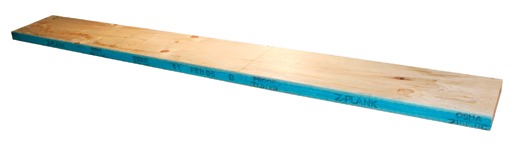 .
Masonry: What information and advice can you give contractors concerning the disposal of damaged or un-useable scaffold plank?
Kennison: Cutting damaged planks into mudsills or non-useable lengths is a good way to prevent future use. Never dump or abandon a damaged plank, since the discarded plank may end up being used by someone else. When discarding contaminated planks, assure they are disposed of properly per any regulatory requirement, based on the type of contamination.
It is never a good idea to burn damaged planks as a means of disposal. The different chemicals associated with concrete, mortar and plaster may emit harmful fumes, and cause particles to become airborne, polluting the air.
.
Masonry: What information and advice can you give contractors concerning the disposal of damaged or un-useable scaffold plank?
Kennison: Cutting damaged planks into mudsills or non-useable lengths is a good way to prevent future use. Never dump or abandon a damaged plank, since the discarded plank may end up being used by someone else. When discarding contaminated planks, assure they are disposed of properly per any regulatory requirement, based on the type of contamination.
It is never a good idea to burn damaged planks as a means of disposal. The different chemicals associated with concrete, mortar and plaster may emit harmful fumes, and cause particles to become airborne, polluting the air.
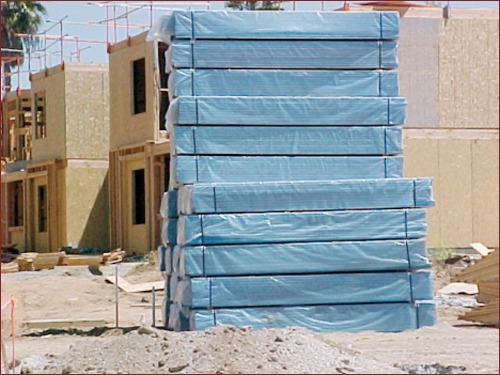 Protecting planks from excess water
Masonry: What should contractors look for when purchasing legitimate scaffold plank?
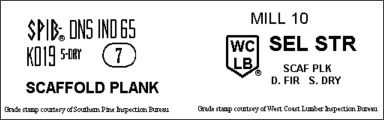
Kennison: When contractors are looking for suppliers of OSHA-compliant, solid sawn scaffold plank, they should assure each plank has the following features:
Protecting planks from excess water
Masonry: What should contractors look for when purchasing legitimate scaffold plank?
Kennison: When contractors are looking for suppliers of OSHA-compliant, solid sawn scaffold plank, they should assure each plank has the following features:
- An OSHA marking that signifies it meets OSHA standards for solid sawn scaffold plank
- All solid sawn wood planks should be rated as “scaffold plank” grade and should be certified by, or bear the grade stamp of, a grading agency approved by the American Lumber Standards Committee (ANSI A10.8-2001)
When contractors are looking for suppliers of OSHA-compliant, LVL scaffold plank, they should assure each plank has the markings of:
- A third-party inspection agency logo (LVL mills must be inspected by an independent agency to ensure they meet all manufacturing requirements)
- A manufacturers name and mill number (notes manufacturer and date they were made)
- A “SCAFFOLD PLANK” stamp
- An OSHA marking that signifies it meets OSHA standards for LVL scaffold plank
- Design properties must be published by the manufacturer;?? LVL scaffold plank that are proof tested are recommended, but not required.
Return to Table of Contents