January 2013: Making the Grade
Words: Dan Kamys
Making the Grade
By J. David Holt
Maybe Christian Rodriguez didn’t have a plan when he graduated from high school in Oklahoma, but he does now.
After a year of junior college, Rodriguez decided that he was “not ready” for more school. He enlisted in the U.S. Army and served three years in the infantry. Following his own military service, he temporarily moved to Washington, D.C., to provide care for his brother-in-law, who had been severely injured in combat in Afghanistan.
Back home in Broken Bow, Okla., he thought about the G.I. Bill. “My Mom was one of my motivations in going back to school,” Rodriguez says. “She kept telling me that it’s never too late to make something of yourself.
“I thought I should take advantage of the G.I. Bill, and my mother did, too,” he continues. “I had done some construction. My brother builds homes. So, I enrolled in the masonry program at Kiamichi Technology Center in Idabel , Okla. I was surprised. I was better than I thought I’d be.”
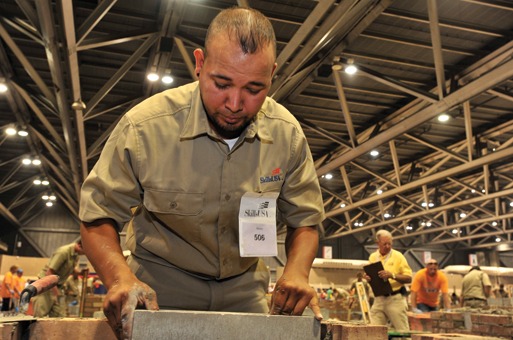 Christian Rodriguez is on a path to success.
His masonry instructor, Jeff Dunn, says he was a very good student. “He started as a full-time student, and, after his first year, Christian finished second in the state masonry competition. He finished the program this year (2012), took first place in the state contest and competed in the national competition in Kansas City.”
Rodriguez called Dunn’s class a “great experience” and his trip to Kansas City for the SkillsUSA National Masonry Championships a “once in a lifetime experience.”
“He was an excellent student,” Dunn concludes. “I wish I had a room-full of students like him.”
The student-teacher relationship continues. “I’ve gone out on my own,” Rodriguez says. “I’m trying to build a business. Mr. Dunn refers work to me that the school and his students can’t do.”
Dunn says Rodriguez has taken the initiative to print business cards, has decals on his truck and has even run advertising in the local newspaper. In the meantime, he is taking full advantage of the G.I. Bill by taking additional courses at Eastern Oklahoma University, where he plans to pursue a degree in construction management.
Rodriguez also is taking advantage of a savings program offered by his Choctaw Tribe. “The Choctaw Asset Building (CAB) Program is a two-to-one matched savings program for start-up businesses,” Rodriguez explains. “So, by the time I get my degree, I should have saved enough to buy the equipment I’ll need.”
Christian Rodriguez has a plan.
Return to Table of Contents