Brick Cladding: Helping to Keep the Moisture Out
Words: Dan KamysOctober 2014
Every year, the summer solstice marks the beginning of summer in the Northern Hemisphere. The season brings with it longer days, festivals and time at the pool, but also humidity interchanged with dryness. In many parts of the country, periods of intermittent rain showers followed by stretches of blistering heat are common. Nonetheless, these variations in climate can lead to an increase in wall moisture and negatively impact the safety and structural integrity of a home.
While construction techniques have advanced, structures have become significantly more energy efficient and airtight. Building codes and consumer demand for comfortable, energy-efficient homes has increased. Although better for the energy bill, these practices minimize the amount of moisture movement and natural drying in the building envelope. Trapped moisture, if not addressed, can lead to problems such as mold and deterioration of the building components.
Maintaining a consistently dry wall assembly provides certain advantages:
• Lower humidity can inhibit mold development.
• Over time, high wood stud wall cavity humidity levels can compromise the performance of wood and wood products, such as studs and sheathing. Wood stud wall cavities with consistently low humidity, can minimize damage to wood and wood products, and help maintain structural integrity.
• Damp wood and wood products provide an ideal breeding ground for bacterial growth and insect infestation. Wall assemblies, including a nominal one-inch air space, can provide rapid drying, which can hamper bacteria growth and insect infestations.
As part of an effort to better recognize the performance of wall assemblies in mixed-humid climates, the U.S. Department of Housing and Urban Development worked with the U.S. Department of Agriculture’s Forest Products Laboratory and the Brick Industry Association to conduct a year-long field study on the effects of moisture. According to the National Association of Homebuilders, the study was the result of “the increase in moisture-related problems in new residential homes, combined with the popularity of absorptive claddings in moist climates.”
The field study examined eight popular and commonly used sidings, including: vinyl sided wall, stucco clad wall with one layer of felt, stucco clad wall with two layers of felt, stucco clad wall with vented cladding, stucco wall with plywood sheathing, wall clad with manufactured stone, fiber cement siding wall, and brick veneer. Aimed at examining the performance of wall assemblies in the presence of periods of extended heat and moisture, the study also considered how wall design factors enhanced the durability of energy-efficient walls.
Over the span of the 12-month testing period, 44 sensors designed to detect and analyze moisture content, temperature and relative humidity were affixed to the wood framing or sheathing in varied test points on each sample. The moisture levels were recorded in natural elements like precipitation and wind-driven rain, as well outdoor and indoor temperatures and humidity. The sensors were dispersed on the sampled walls to take into account assorted temperatures – increased coolness closer to the ground or excess warmth near the roof. To ensure accuracy, each sensor transmitted new readings every 30 minutes during the testing period.
Researchers also utilized controlled injections of water behind the cladding to determine the draining capabilities of the walls. Other tests included computer simulations that predicted moisture levels, both in magnitude and seasonal phases.
At the conclusion of the examination period, it was clear that of all the assemblies tested below the industry-recognized moisture content threshold level (16 percent).
The study also revealed that:
• Walls constructed with an air gap saw no sustained increase in moisture.
• When bulk water gets behind stucco, a second layer water resistive barrier (WRB) is vital. According to researchers “stucco-clad walls with two layers of WRB had virtually no increase in moisture content while the stucco-clad walls with a single layer of WRB realized moisture increases of up to 3.5 percent.”
• Orientation and solar exposure proved to be crucial elements in wall performance. In every case, north-facing walls experienced higher moisture and humidity readings than the south-facing walls in the same construction.
• Two factors worked to secure lower moisture content throughout the test claddings: wall temperature and air circulation. Higher wall temperatures resulted in lower moisture content. Air movement controlled the drying capabilities of the cladding.
• In most cases, the effects of a wall penetration will not change the moisture performance of the wall.
• North-facing with manufactured stone and north- and south-facing stucco-clad walls with plywood sheathing exhibited the poorest performance from the perspective of highest initial moisture content. The wall cavities for these two assemblies were the slowest to dry.
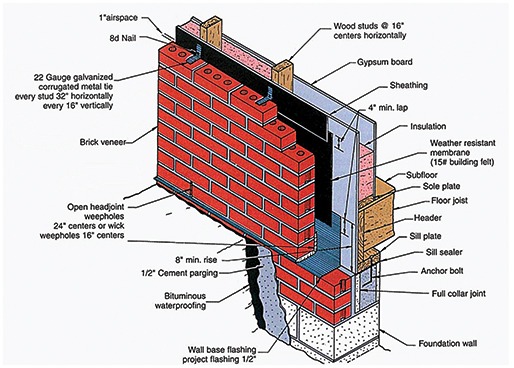
Because its typical construction contains a nominal one-inch air space behind the cladding, brick veneer wall assemblies were the most consistently dry. Results of the study proved that brick construction consistently produced a wood stud wall cavity with lower humidity. The one-inch air space also allowed for rapid drying, inhibiting the growth of bacteria that damp wood could promote. Additionally, darker claddings, like brick, maintained the highest wood stud wall cavity temperature. Because lower humidity can inhibit mold development, brick veneer wall assemblies meet the “Conditions Necessary to Minimize Mold Growth” of ASHRAE Standard 160.
Experts throughout the industry recognize the importance of proper ventilation as an important element of moisture control. In hot and humid climates, seasonal condensation issues indicate that the wall assemblies need to resist the intrusion of bulk and vapor water. Often, increased air movement brings more moisture into the wall cavity, reducing the drying opportunities. As industry leaders have called for additional ventilation, the shortcomings of current and past moisture control strategies have been exposed. In addition, considerations like the cladding type, climate, geographic orientation and wall assembly are important. The amount of annual rainfall can be used as a guide for determining the level of moisture management needed in a wall. No matter where homeowners live, brick wall assemblies can promote dryness that helps maintain the structural integrity of a beautiful home.
For more information, visit www.boralna.com.
Return to Table of Contents